Organic semiconductors are promising materials for optoelectronics due to their properties resembling conventional semiconductors combined with easy processing and a variety of organic materials. Considerable Stokes shift, large optical gain and possibility to avoid concentration quenching in the solid state by controlling intermolecular interactions make organic semiconductors attractive as a novel laser gain media [1-3]. Organic semiconductor lasers (OSL) promise easy tunability of lasing wavelength over the entire visible spectrum [3, 4] due to the broad fluorescence band of organic molecules and possibility to control materials photophysical properties via chemical engineering. However, to date, there were no reports on electrically driven OSL which is a consequence of problems associated with poor charge transfer in the organic media. One approach to the issue is the search and study of the new multifunctional molecules composed of several fragments carrying different functionalities [5].
In this work we present study of photophysical properties of multifunctional fluorene/carbazole compounds [6] and their perspectives to be used as OSL gain media. Suitability of material for OSL operation is characterized by its short transient fluorescence lifetime $\tau_f$ and high photoluminescence efficiency $\Phi_{PL}$, since radiative decay rate $k_r=\Phi_{PL}/\tau_f$ is directly proportional to Einstein's B coefficient, Eq. (1):
$$B \propto \frac{c^3}{8\pi h v_0^3} k_r \tag{1}$$
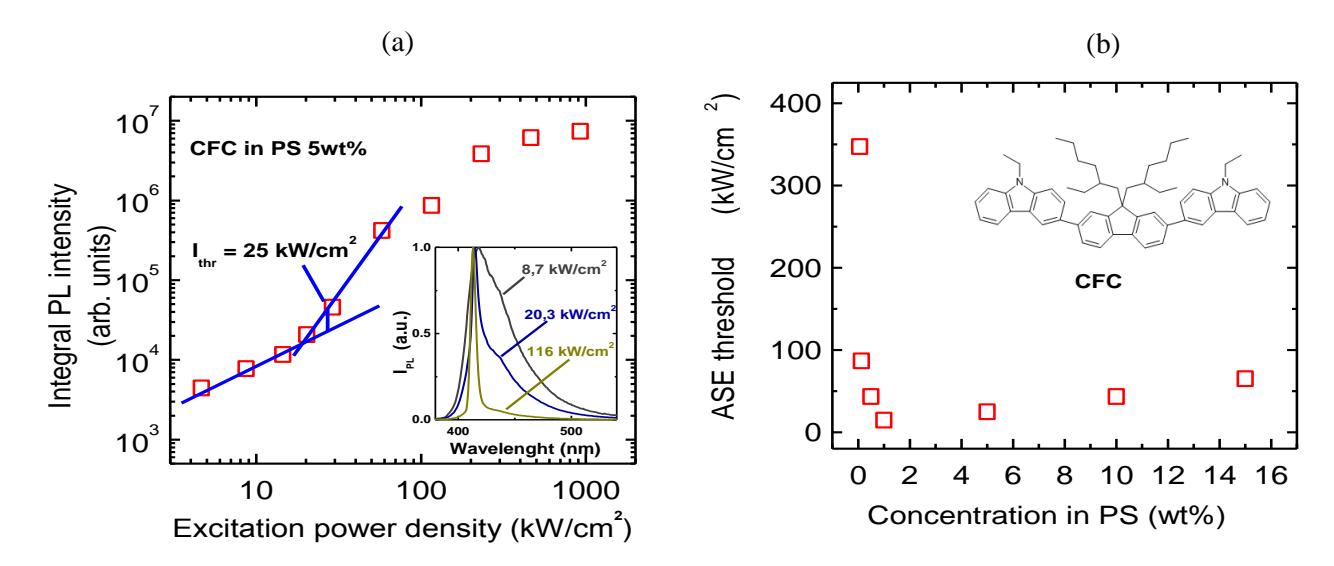
where h is Planck's constant, $v_0$ is the frequency of light and c is the velocity of light. One of the straightforward methods for experimentally determining materials ability for lasing is by measurement of amplified spontaneous emission (ASE). 3rd harmonic of Nd3+:YAG laser (355nm, pump pulse 10 ns) was employed to excite samples. To determine the threshold of ASE Ithr (Fig. 1 (a)) excitation power density was varied by several orders of magnitude. Fluorene-carbazole derivatives were embedded in a solid polystyrene (PS) matrix. Films were casted from THF solution.
CFC compound (Fig. 1(b) inset) showed best results with $\Phi_{PL}$=100$\pm$5% and $\tau_f$=1ns in a solution, which resulted in a distinctly low Ithr=0.6 kW/cm2. However, $\Phi_{PL}$ dropped significantly in a neat film to 18% (Ithr=160 kW/cm2), which can be explained by fluorescence quenching via exciton migration. In a solid PS matrix at low concentrations such quenching mechanism is negligible which resulted in $\Phi_{PL}$ values of up to 48% (Ithr=22kW/cm2, Fig. 1(b)) in optimal
concentration of 1wt%. Lower values of fluorescence quantum yield compared to $\Phi_{PL}$ in a solution were showed to be a consequence of twisted conformers present in a rigid matrix of PS.