
One of the most promising ways to obtain laser radiation of petawatt level is using optical parametric chirped pulse amplification (OCPA) [1]. Infrared or second harmonic radiation of Nd or Yb doped high power lasers are used as a pump source for these parametrical amplifiers. Several laser systems based on OPCPA have been implemented, operating at repetition rates as high as 1 kHz or output energies beyond 100 mJ while maintaining the pulse duration of 9-10 fs. Typical configuration of these systems is as follows: fs master oscillator, pulse stretcher, regenerative amplifier using Nd doped laser material optically or electrically synchronized with master oscillator and producing pulses of 50 to 100ps duration, power amplifier for producing OPCPA pump pulses of 10 to 1000 mJ energy, OPCPA stage and compressor. Though this technique is well known it is still a challenge to produce a reliable pump laser
There is special interest in laser systems operating at higher than 100Hz repetition rates. In this work we concentrated on creating a ps pulses amplifier operating at 1kHz repetition rate based on laser diode (LD) pumped Nd:YAG modules. We have not paid special attention to synchronization of fs and ps systems as it is well established technology [2]. Despite good total efficiency of LD pumped laser systems thermal distortions in laser rod severely affect laser beam quality. In presented work we concentrated on depolarization compensation and beam profile modulation elimination. Nd:YVO crystal based mode-locked laser running at 1kHz repetition rate producing 48ps and 1mJ pulses was chosen as seed source for amplifier.
A 2-pass scheme, with image relaying from active medium to a returning mirror and back, was chosen experimentally (Fig.1). A Faraday rotator is used to rotate the polarization. Having passed through the Faraday polarization rotator twice tangential and radial polarization components exchange places, therefore, during the second pass through an active medium the effect experienced by different polarization components is equalized. This also helps compensate the difference in thermal lens optical power for different polarization components. Unlike a quarter-wave plate Faraday rotator's effect is independent of the incident radiation's polarization direction, thus making it more suitable for depolarization compensation. To weaken the non-linear interaction a quarter-wave plate is used before a laser module. This turns linearly polarized light into circularly polarized light before passing through the laser module. Non-linear interaction is 1.5 times weaker for circularly polarized light than for linearly polarized light. To prevent air breakdown due to high intensity a vacuum cell is placed in the image relaying telescope, which is used to preserve spatial constituents of the beam.
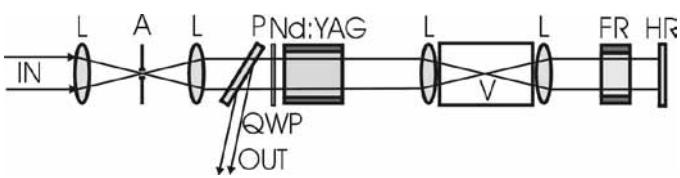
The final amplifier system can be composed of several of described amplifier cascades. Image relaying is performed between separate amplifier cascades to preserve the needed intensity distribution. Image relaying telescope with aperture is also used to perform spatial filtering of the beam. This improves the quality of the beam and removes small-scale spatial irregularities caused by non-linear interaction, which could otherwise cause self-focusing of the beam. The telescope could be used to increase the diameter of the beam where needed. An isolator, consisting of a Faraday rotator and half-wave plate, is also placed between separate amplifier cascades, protecting the system from unwanted reflection and depolarized light amplification in preceding amplifier cascades.
A system composed of 3 aforementioned amplifier cascades using laser chambers with rod active media of 3, 5 and 6.3mm in diameter was realised. Pulse energies of about 70 mJ were reached with up to 52% conversion efficiency to second harmonic. The M2 parameter of the beam was 3.4 for both the vertical and horizontal axis. The intensity distribution was quite homogeneous. Experiments using chamber with a 7mm rod are planned.