Diamond-like carbon (DLC) films possess many excellent properties, e.g. high hardness; high wear resistance, low friction coefficients, atomic-level smoothness and high transparency. Thus these films are often used to improve mechanical and tribological properties of soft materials [1]. The incorporation of additional elements (Si, SiO, Ag, Au, etc.) in the films gives further improvement of film properties and wider application possibilities [2]. Introduction of certain amount of silicon and oxygen into DLC enables to change optical properties of the film and to produce films with the reduced residual stress level and coefficient of friction [3].
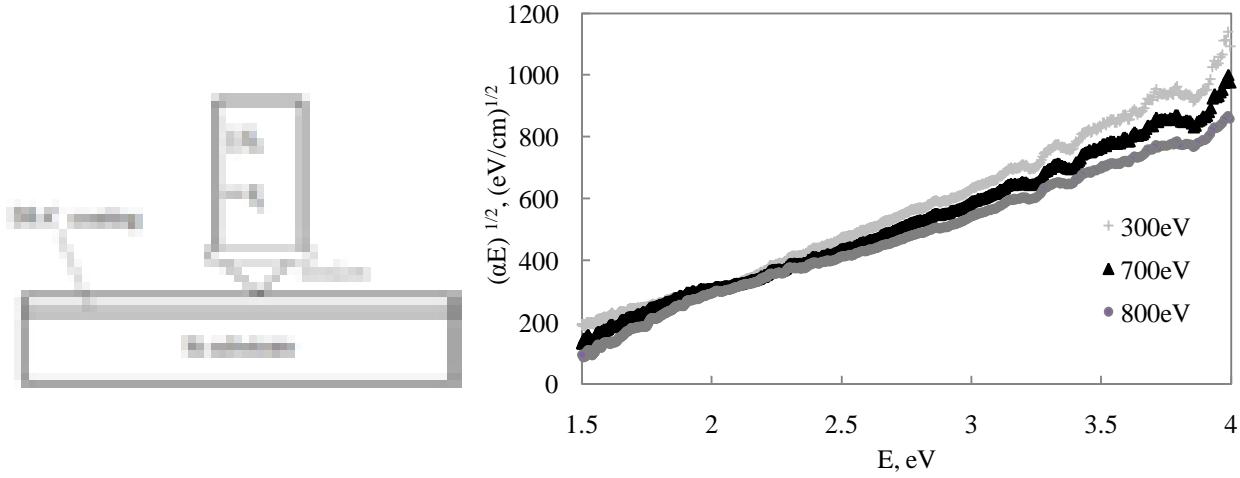
In the present research the optical and mechanical properties of SiOx doped DLC (DLC:SiOx) films were analysed. DLC:SiOx films (with thickness of 200 nm) were formed from hexamethyldisiloxane with acetylene carrier gas employing closed drift ion beam source changing ion beam energy from 300 eV to 800 eV. As substrates p-type silicon (100) and fused silica were used. Determination of mechanical properties was done using homemade scratch tester with Berkovich type indenter and maximal force of 250 mN. The experiment was carried out gradually increasing normal force $F_N$ and registering tangential force $F_T$. The principal experiment scheme is shown in Fig. 1. For every sample at least three scratches were done and force value as a function of scratch dimensions was registered. The scratch mark left after the applied load was investigated employing optical microscope. Employing this technique one can evaluate the adhesion of coatings on the substrate. Analysing scratch track, one can determine the critical force (peel off). The friction coefficient was determined from following equation:
$$ \mu = \frac{F_t}{F_n} \tag{1} $$Optical properties (optical bandgap) of the films were evaluated by measuring transmittance and reflectance (spectrometer "Avantes", 200-1000 nm) of the films formed on fused silica. The absorption coefficient was calculated from following equation:
$$ \alpha = \frac{1}{t} \left( \frac{1 - R}{T} \right) \tag{2} $$Here t is film thickness in cm, R, T - reflectance and transmittance coefficients respectively.
The optical band gap $E_g$ of the films was determined employing Tauc formula $\sqrt{\alpha E} = \beta(E - E_g)$, where $E$ is the photon energy and $\beta$ is the Tauc slope (approximating linear part of a graph, see Fig. 2). The energy $E_{04}$ (energy when $\alpha=10^4$ cm-1) was also determined and values compared with Tauc gaps. The optical bandgap dependence on ion beam energy was determined.