
The Swedish warship "Vasa” is one of the largest marine archaeological artefacts in the world. After the salvage in 1961, after more than 300 years in the sea, it has been preserved by spraying polyethylene glycol – one of the first reliable and relatively simple methods for preservation [1, 2]. During its time at the sea bottom as well as in a museum hall, the wood of the "Vasa” experienced a lot of changes. These changes cause degradation of the wood which may not be visible at first sight. It is important to determine the main causes to the deterioration of the wood condition in order to ensure its proper preservation in the future; thus many studies have been carried out on the “Vasa”, however the degradation processes are still uncertain [2]. Fourier transform infrared (FTIR) absorption spectroscopy is applied for investigation of the “Vasa” in this work. The infrared spectra are like 'fingerprints' of the molecular compounds. Thus, by analysing the spectra one can determine chemical composition or, as in this case, chemical changes occurring compared to the reference sample.
Infrared spectra were recorded using a Hyperion 3000 IR microscope combined with an IR spectrometer IFS66V/S from Bruker (Max-Lab laboratory, Lund, Sweden) with globar IR light source and a single point MCT (mercury cadmium telluride) detector. The samples were prepared using the KBr (potassium bromide) pellet technique.
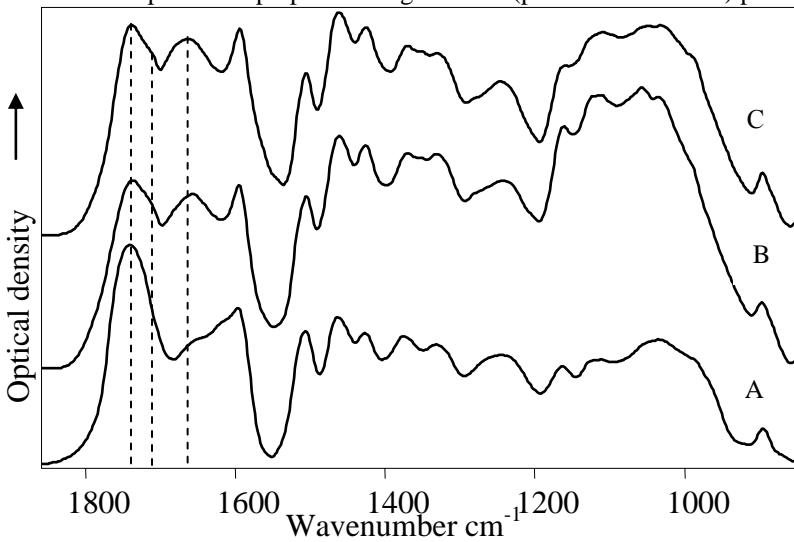
Differences between the spectra of the “Vasa” wood and fresh oak wood (used as a reference) indicate degradation of the timber due to oxidation as well as alterations in functional groups of the wood polymers (cellulose, hemicelluloses, lignin). For example, new spectral band appearing at 1666 cm-1 (Fig. 1) is probably caused by conjugated C=O stretching vibration. Conjugated C=O bond could be formed in lignin in the course of oxidation reactions caused by the presence of iron ions (Fenton's reactions) [2].
In conclusion, with the aid of FTIR microspectroscopy, degradation of polysaccharides and lignin could be monitored. Spectral changes indicate oxidation of organic molecules in the wood occurring in the presence of iron ions. Differences in chemistry between surface and inner samples, for example, the amount of polyethylene glycol (PEG) – the preservation material - in the wood can be observed as well.