Discovery of self-mode-locked Ti:sapphire lasers revolutionized the development of ultra-short laser systems. Typical pulse energy of these lasers varies from nanojoules generated in laser-oscillator to several milijoules in regenerative amplifiers and is sufficient for nonlinear optics or ultra-fast spectroscopy experiments, but laser-matter interaction experiments demands higher pulse energy, which is impossible to attain by unamplified pulse [1].
There are two ways to amplify chirped pulses: chirped pulse amplification in laser material (CPA) and optical parametric chirped pulse amplification (OPCPA). Both methods are based on pulse stretching, amplification and pulse compression. When short pulse is stretched in time its peak power is reduced and capability to damage amplifying crystal or laser material is lowered. An important parametric amplification feature is the possibility to use several pump beams. Each of pump beams must satisfy the phase-matching condition and generated idler pulse eliminates phase difference between pump and signal pulses [2].
The goal of this research was to design and investigate a two beam pumped parametric chirped pulse amplifier. Ti:sapphire oscillator was used to generate femtosecond pulses which were stretched in a bulk SF57 glass up to 10 ps. Pump pulses were generated in two parallel Nd:YAG regenerative amplifiers. The duration of pump pulses was ~50 ps and pulse energy of each channel was ~2,3 mJ. Stretched broadband seed pulses were amplified parametrically in a noncollinear configuration in two subsequent BBO crystals.
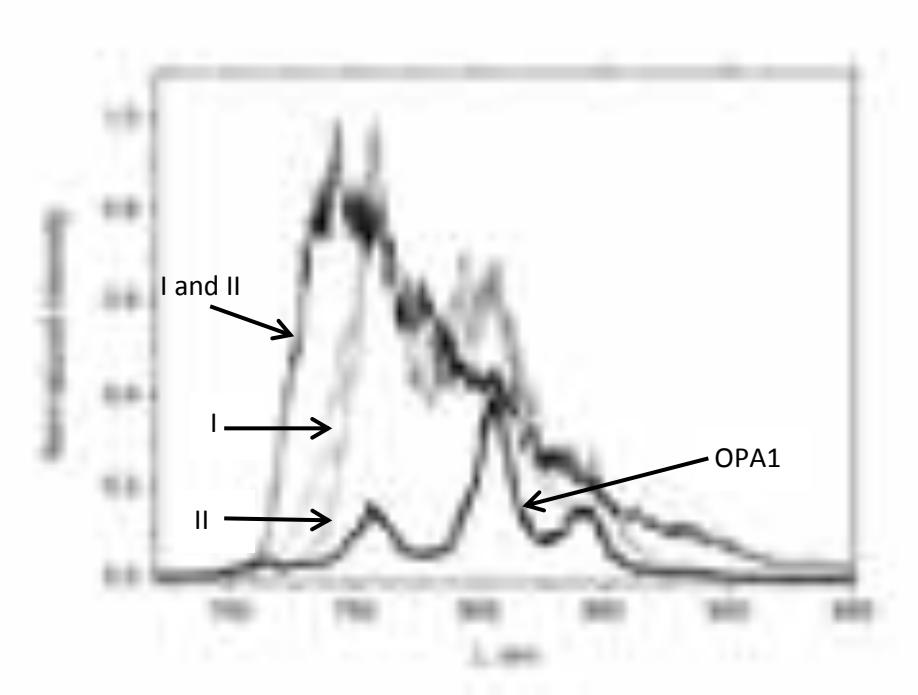
In order to examine properties of designed parametric amplifier we measured energy and spectrum of amplified pulses. After two amplification stages all broadband spectrum of Ti:sapphire laser was amplified. Pulse is amplified 5·105 times and the efficiency of amplification is 7 %. Spectra are shown in Fig. 1. The amplified signal spectrum in two-beam pumped configuration was shown to be as broad as in a single-beam pumping configuration and different pumping geometry is considered for increase of parametric conversion efficiency.