
Nitride compound semiconductors are widely used in light-emitting diodes (LEDs) for ultraviolet and visible spectra. However the nitride-based LED fabrication encounters some problems such as a large number of threading dislocations in the active layer. This leads to non-radiative recombination processes that lower the light-emitting device efficiency and accelerate device ageing [1].
Investigation of noise is known to yield valuable information on dominant physical processes in semiconductor materials and structures [2].
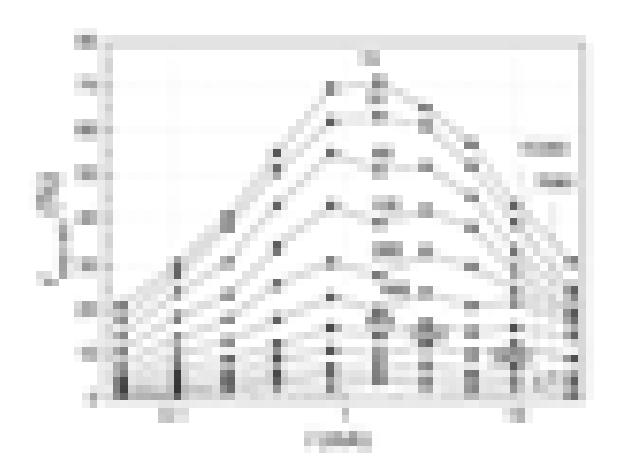
In this experiment output light power, current-voltage and noise characteristics of blue LEDs have been measured at room temperature in current range from 0,049 mA to 21 mA. We used Cooley-Tukey fast Fourier transformation for measurements of noise spectra in the frequency range from 10 Hz to 20 kHz. A special attention was pointed to the measurement and interpretation of simultaneous cross-correlation factor between electrical and optical fluctuations. In order to evaluate the correlation factor, the electrical and optical fluctuations measurements were performed simultaneously. Processing of noise signals was produced with two identical channels comprised from custom made low noise amplifiers, filter systems, analog digital converter (National Instrument PCI-6115 card). The cross-correlation was measured over full frequency range and in every one-octave frequency range.
The simultaneous cross-correlation factor in the frequency band from 10 Hz to 20 kHz was measured on the ground of this expression:
$$r_{\text{exp}} = \frac{\left\langle u_{\text{el total}}(t) \cdot u_{\text{phtotal}}(t) \right\rangle}{\sqrt{\sigma_{\text{el } \Sigma}^2 \cdot \sigma_{\text{opt } \Sigma}^2}}\tag{1}$$Where brackets < > mean averaging both on time and on number or realizations.
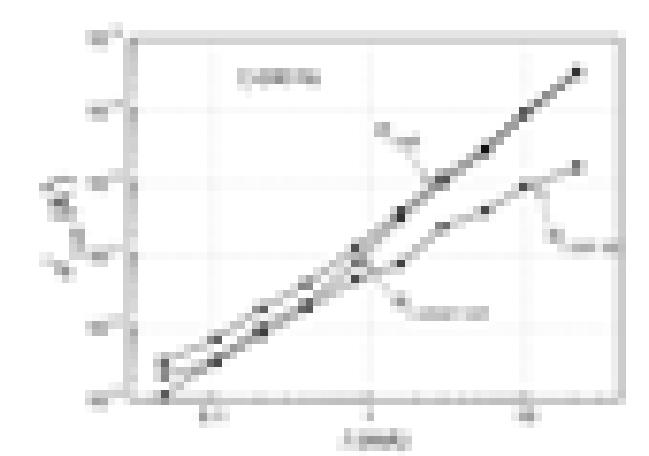
It is seen from Fig 2 that at low currents optical fluctuations are caused by defects near quantum wells, because the correlated part of the fluctuation is almost equal to the total level of fluctuations. At high currents the correlated part is about an order lower than the total level of fluctuations. It shows that the main part of recombination centers is in the passive layers of the LED.