
Semiconductor nanocrystals, called quantum dots (QDs), are inorganic particles with unique size-dependent optical and electrical properties due to quantum confinement. The combination of the size-tunable narrow photoluminescence (PL) spectra, high quantum yield, broad absorption spectra with large extinction coefficients and extreme photostability has already verified QDs as effective labels for biological imaging [1]. Presently, QDs are widely studied as potential energy donors to photosensitizers (PSs) with the intent of applying such QD-PS conjugates in the photodynamic therapy of cancer (PDT) [2]. There are certain requirements for optimal PDT photodrug, including the most important requirement to generate singlet oxygen (1O2), which is a main reactive intermediate in photosensitized cancer cell killing.
In this work, we present a steady-state spectroscopic study on the photostability and 1O2 generation of water-soluble CdSe/ZnS QDs and photosensitizer chlorin e6 (Ce6) complex. The formation of 1O2 was measured with the fluorescent dye singlet oxygen sensor green (SOSG). The irradiation of samples was performed using continuous 460 nm light source (106.4 mW/cm2). Since the absorption of Ce6 at 460 nm is minimal, this allows estimating 1O2 amount produced by QD-Ce6 complex via energy transfer from QDs to bound Ce6 molecules only.
The emission intensity changes under 460 nm irradiation of 20 nM QD, 0.2 μM Ce6, and QD-Ce6 ($c_{\text{QD}}$=20 nM, QD:Ce6 molar ratio 1:10) aqueous solutions (PB pH 7) at respective maxima are shown in Fig. 1A. After 134 J/cm2 irradiation dose, the fluorescence intensity of pure Ce6 solution decreased by 5%, while the PL intensity of pure QD solution did not change significantly. The irradiation of QD-Ce6 solution produced a large decrease in the fluorescence of bound Ce6 at 670 nm, while QD emission at 630 nm was increasing simultaneously. After 128 J/cm2 irradiation dose, the fluorescence intensity of bound Ce6 decreased by 77%, while QD PL intensity increased 3.6 times. The recovery of QD PL intensity is associated with the photobleaching of bound Ce6 molecules as energy acceptors.
The emission intensity changes of SOSG fluorescence at 528 nm under 460nm irradiation of pure QD, Ce6 and mixed QD-Ce6 solutions are presented in Fig. 1B. Any significant changes in SOSG fluorescence intensity in neither QD, nor Ce6 pure solutions were observed. However, irradiation of QD-Ce6 solution produced a significant increase in intensity of SOSG fluorescence confirming that QD-Ce6 complex is able to generate 1O2.
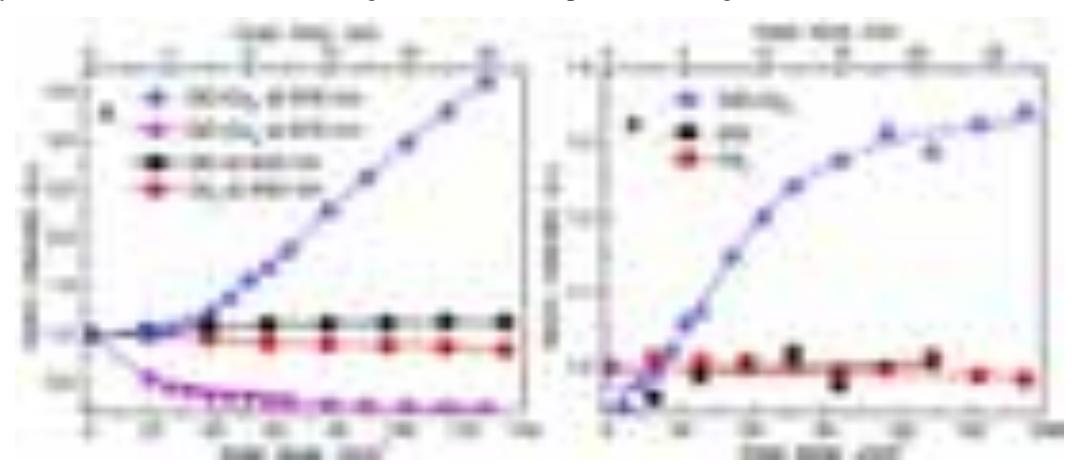
We conclude that QD-Ce6 complex activated by light is able to produce 1O2 more effectively than QD or Ce6 alone. The generation of 1O2 within QD-Ce6 complex occurs via energy transfer from QD to bound Ce6 molecules. 1O2 generated by bound Ce6 molecules reacts with Ce6 itself causing its photobleaching.