
Fluorescent organic nanoparticles (FONs) with dimensions ranging from tens to few hundreds of nanometers have attracted much interest because of their potential technological application in optoelectronic systems, such as organic light emitting diodes or fluorescence sensors [1]. These nanoparticles are usually formed from non-planar molecules that are non-emissive in the solution, but demonstrate high fluorescence intensity when aggregated. The so called aggregation-induced emission (AIE) phenomenon occurs only in certain-structure-containing molecules, which leads to specific molecular packing and restriction of intramolecular torsions in the aggregated state [2].
In this work, fluorescent organic nanoparticles based on novel divinylbenzene derivatives with cyano groups were formed by a simple reprecipitation method in the aqueous phase. Different volume fractions of distilled water were injected into chromophore/THF solution under vigorous stirring. In all samples concentration of chromophore was kept constant. Consisting of different end-groups, divinylbenzene derivatives were studied and compared in regard to nanoparticle formation morphology and fluorescence turn-on ratio.
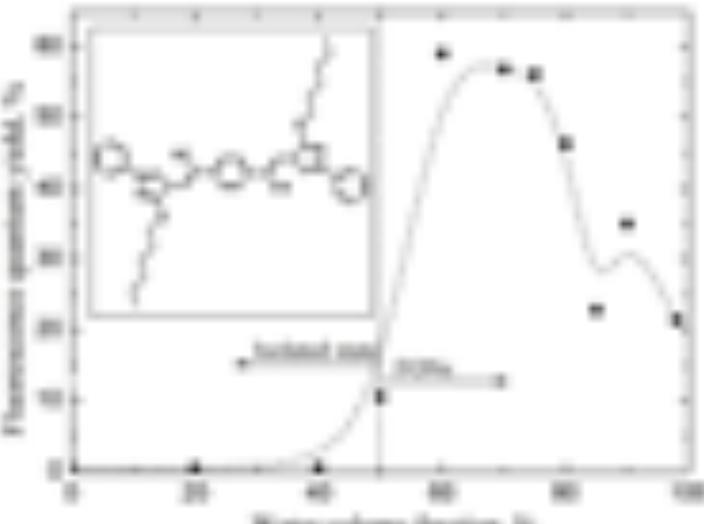
Formation of FONs was examined by performing optical spectroscopy and electron microscopy measurements. Isolated molecules in a dilute solution exhibited very low fluorescence quantum efficiency (0.6%). Divinylbenzene derivatives became highly emissive upon aggregation into nanoparticles due to the restriction of intramolecular torsions and due to the specific molecule arrangement in the nanoparticles. The possibility to control the fluorescence turn-on ratio by exploiting various end-groups of cyano-substituted divinylbenzene derivatives was demonstrated. Maximum increase of the fluorescence quantum yield by a factor of 100 upon formation of FONs in water/THF mixture was observed (Fig. 1.). The latter result is promising for possible technological application of divinylbenzene based FONs in sensing of water/organic vapor via fluorescence "on/off" switching.