Nowadays light-emitting diodes (LEDs) span all visible light spectrum and beyond. Nitride-based materials are used for green-blue radiation, to cover ultraviolet region, also for white LEDs.
However, nitride layers in heterostructure lead to additional defects due to lattice mismatch with substrate [1]. Also phosphor layer used in the white LEDs can be additional source of device degradation. The defects worsen LED optical and electrical characteristics, increase leakage current that lowers LED efficiency and accelerates degradation processes [2]. The questions: in which part of the structure defects appear, how they influence device operation characteristics and how they behave during device aging, are always actual for any semiconductor structure. At this point, noise investigation gives valuable information and is useful for evaluating semiconductor device quality and predicting lifetime [3].
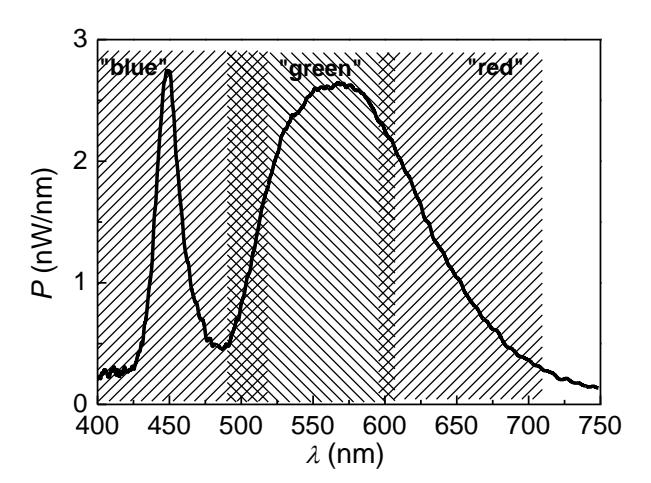
The aim of the work was to investigate white light emitting diode low frequency noise characteristics, to clear up physical processes that take part in different parts of the LEDs and influence their lifetime. High power nitride-based white light emitting diode has been investigated. Noise characteristics (electrical noise and optical noise spectra, cross-correlation factor) have been measured in low frequency (20 Hz – 20 kHz) region for initial samples and after accelerated aging. LED output light power and optical noise signal is measured by 3 photodiodes array. These photodiodes (PDs) are sensitive to different part of visible spectrum: the first PD sensitivity maximum coincides with blue light peak (around 460 nm), the third – with broad phosphorous radiation peak ((540-700) nm). Therefore, we are able to separate and investigate different parts of the white LED optical spectrum: “blue” optical signal from the active region and "phosphorous" - from the phosphor layer. Such division of radiation spectrum enables us to separate physical processes that take part in different parts of the structure and find out, which of them influence device degradation foremost. There is positive (40-50) % cross-correlation between electrical fluctuations and “blue” optical noise signal; similar cross-correlation is observed between electrical and “phosphorous” optical noises. Such cross-correlation values are observed at low frequencies, where 1/fα-type fluctuations dominate both in optical and electrical noises. Cross-correlation factor is low (close to zero) at frequencies above 100 Hz, where optical shot noise (caused by random photon emission process) is intensive. The results show that there are defects in the investigated LED structure that lead to the 1/fα-type electrical fluctuations and these fluctuations partly modulate current flow through the active region. Cross-correlation between two optical (“blue” and “phosphorous”) signals is high ((80-90) %) and positive over all investigated current region. Therefore, phosphor layer and further light transmission path from the active region to open space do not have any influence to the propagating light.