
Recently, there is a great interest in multiferroics – materials which in the certain temperature range are ferroelectrics and ferromagnetics. The most popular multiferroics are lead – iron niobium Pb(Fe2/3W1/3) and bismuth ferrite BiFeO3. These multiferroics could be used in microelectronics for example, producing MERAM memories.
PFW ceramics dynamic dielectric properties have not been published anywhere, so the aim is to investigate these properties.
In order to produce high quality samples, a modified B-site precursor method was proposed as an effective method to obtain a pure perovskite phase in lead-based ceramics [1]. Pb(Fe2/3W1/3) ceramic was prepared using this method. Dielectric measurements were performed at temperature range (110 – 500) K and in the frequency range (20 – 1000) kHz, (300 MHz – 3GHz) and (24 – 40) GHz. In the low frequency range (20 kHz – 1000 kHz), investigation was performed by measuring samples' capacity and the tangent of loss angle using LCR-meter HP4284A. In the high frequency range (300 MHz – 3GHz) investigation was performed by using network analyzer Agilent 8714ET. Measurements were performed by reducing the temperature of the sample and the temperature variation rate was about 1 K/min.
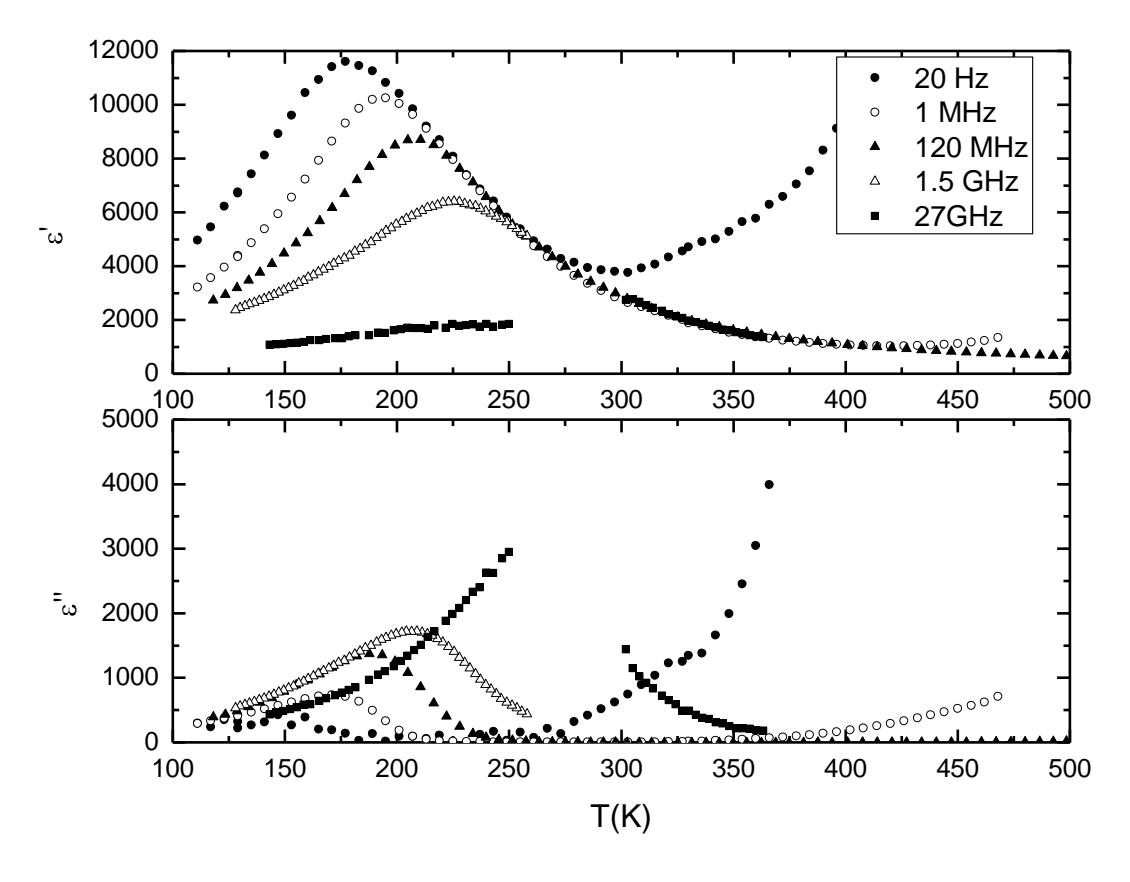
Figure 1 shows the temperature dependence of the real and imaginary parts of dielectric permittivity of PFW+1%MnO2 ceramic. This investigation shows that PFW ceramic is ferroelectric relaxor. We observe the anomaly of dielectric permittivity which is typical for the ferroelectric relaxors at the temperature range less than 300 K: increasing frequency the peak point of the curves of dielectric permittivity moves to the higher temperature range.