Here we present a novel solid-state lighting method for paintings and other visual art scenes. Recently we have shown that solid-state lighting with controlled colour quality can be used to increase the visual attractiveness of fresh fruits and vegetables [1], therefore such a technique can be optimized for the art.
Paintings usually do have an unstable colour appearance in long term time scale due to the permanent exposure of the light. Therefore the proper selection of lighting conditions is of crucial importance. The main recommendation for the art are reviewed in the literature [2]: spectral components of the wavelength shorter than 400 nm and longer than 700 nm have to be eliminated; it is not recommended to use more than 200 lx illuminance for ordinary paintings and more than 50 lx for very sensitive works; the light source has to be characterized with high colour rendition parameters; it is recommended to use a lower correlated colour temperature (CCT) sources meaning the lowering of the blue and red light component ratio; it is noted that radiant exposure instead of luminous exposure is responsible for the long term harm for the paintings, therefore it is recommended to use lighting with a maximized luminous efficacy; paintings accumulate the lighting damage, therefore movement sensors during the exposition time can reduce long term damage. Furthermore the trade-off between visual representation and lighting damage has to be considered since the illuminance below 50 lx reduces colour discrimination.
Art illumination recommendations can be realized and most of the problems solved with smart solid-state lighting. Such a technology is the most advanced for current time since the optimized colour quality white light sources can be designed and easily adopted for certain illumination requirements. For example the fading colours can be compensated by colour-saturating LED cluster containing red, pc amber, green and blue (RAGB) LEDs; aging varnish can be corrected with a higher CCT; an ultraviolet and infrared radiation is easily eliminated by selecting the proper solid-state lamp spectral power distribution; a luminous efficacy can be increased by optimising the primary colour sources; suitable and attractive lighting can be controlled considering art experts, exposition visitors, authors remarks and opinions.
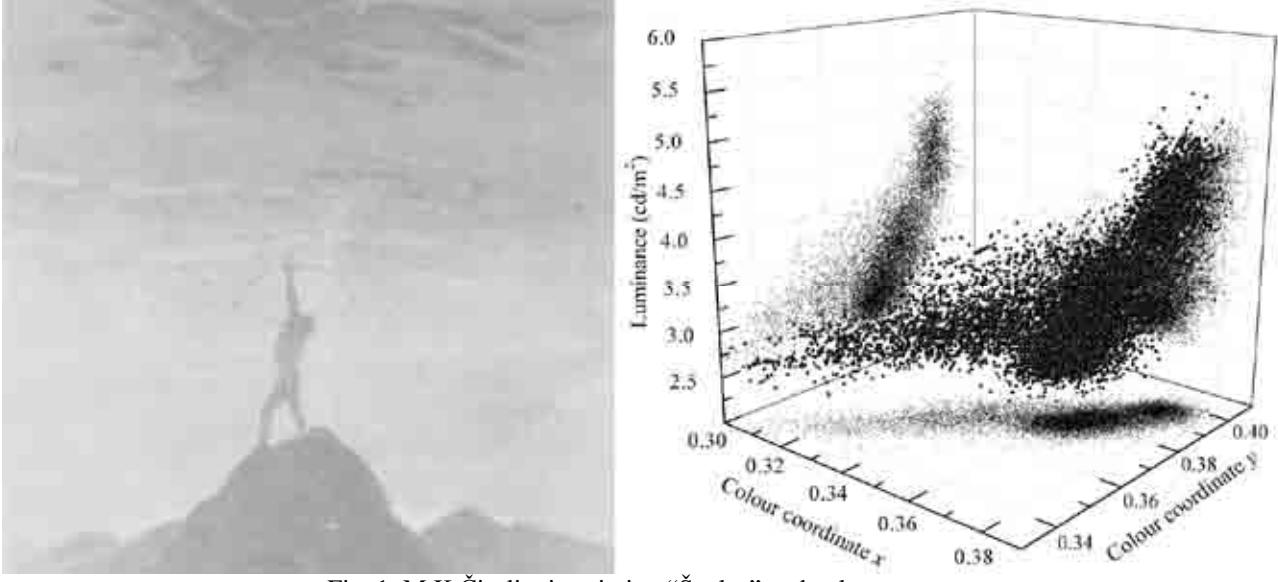
Here we present our recent work with the painting of well-known Lithuanian artist Mikalojus Konstantinas Čiurlionis. His paintings were performed by using lower quality materials and the effects of aging varnish and colour fading can be observed. The research was started by collecting the trismulus values and chromaticity coordinates of the paintings by using the imaging photometer-colourimeter. Whole painting colour gamut can be drawn and lighting effects applied (fig. 1).