
Indium gallium nitride (InGaN) has been the subject of extensive research, because of their wide application in optoelectronics, e.g. for solar cells, because of good spectral match to the sun light. InGaN can cover up light to the near-infrared range, depending on In and Ga concentration ratio. The growth of good In-rich InGaN layers on sapphire substrates is a great challenge, because of lattice mismatch and the different melting temperatures.
This work is devoted to In-rich InGaN films grown by metal-organic chemical vapor deposition (MOCVD) on sapphire. The task was to increase the crystalline quality of In-rich InGaN layers.
InxGax-1N/GaN structures (100 nm InGaN / 3 μm GaN) were grown on sapphire C-plane substrates in a vertical flow close-coupled flip-top showerhead reactor using trimethyl gallium, trymethil indium and ammonia as precursors, hydrogen for GaN or nitrogen for InGaN as the carrier gases. The growth was monitored using in situ laser interferometer, determining process steps, alloy quality and its thickness. In concentration was determined using X-Ray diffraction measurement.
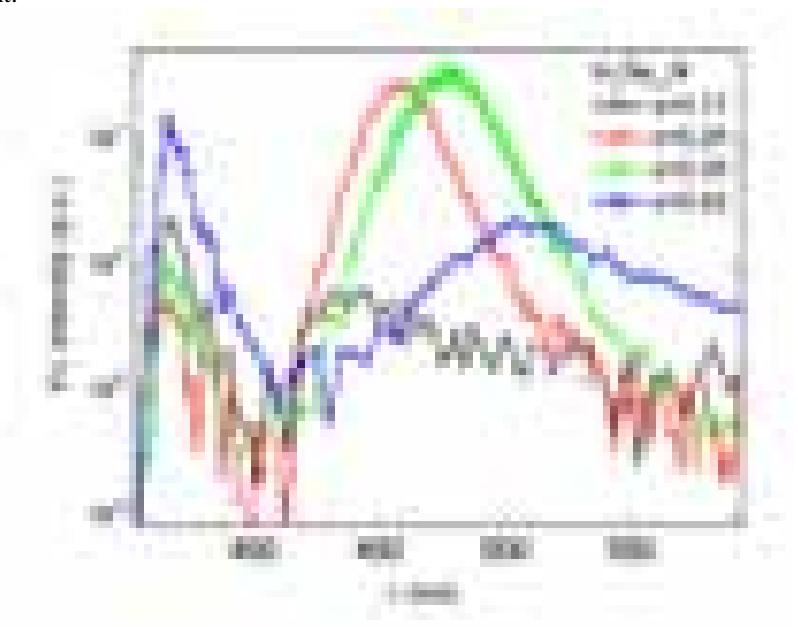
In-rich InGaN layers have been successfully grown with 25%, 35% and 42% In content using transitional InGaN thin interlayer with graded In distribution on GaN template. This additional layer is distributing a tension resulting from the difference between grating periods of GaN and InGaN crystals in a larger volume. It results in a growth of InGaN layer with lower concentration of defects. The improvement of crystalline quality can be observed from photoluminescence (PL) measurements (Fig. 1, x=0.25, x=0.35 and x=0.42). PL efficiency increases several orders of magnitude in the layer with 25% of In compared to the layer grown directly on GaN template (see black empty squares, x=0.17) The growth conditions of interlayer used to enhance crystal quality of In-rich InGaN layers will be discussed.