
After recording seafloor with remotely operating vehicle (ROV) [1] which has high-resolution video imagery we get high quality video material. Since in this field still is a lack of methods for the automatic analysis of these materials. Manual analysis of video material is complex, time-consuming as well as human resources. This problem requires the seafloor video mosaicing algorithm and exists as a main operating part of the image analysis.
Filming of seafloor can be done in different trajectories: straight, spiral and etc, as shown in [2], [3]. With such a variety of materials require different methods of mosaicing. Differences not only scatered of capture trajectory, but also has differences of video material quality, such as the distance from the bottom, water transparency and the result of different shots of lighting and color contrasts differences mismatches [4], [5]. While recording underwater video images appear on the distortions of volatility against the bottom of the ROV positioning. All of this creates problems in order to arrange the frames of the mosaic of the seafloor.
Our goal is to create an algorithm that helps to lay out mosaics of various the seafloor video material, and allow assembly tasks from manual to automated work.
Feature detection and matching:
A pair of overlapping image of the same scene can be related by a motion model. (Fig.1)
Matching the same object on different pictures.
Matching two pictures on the same opacity.
Matching two pictures making one of them more transparency.
Maching pictures making one of them (A or B) cut a $\alpha$ angle. (Fig. 2)
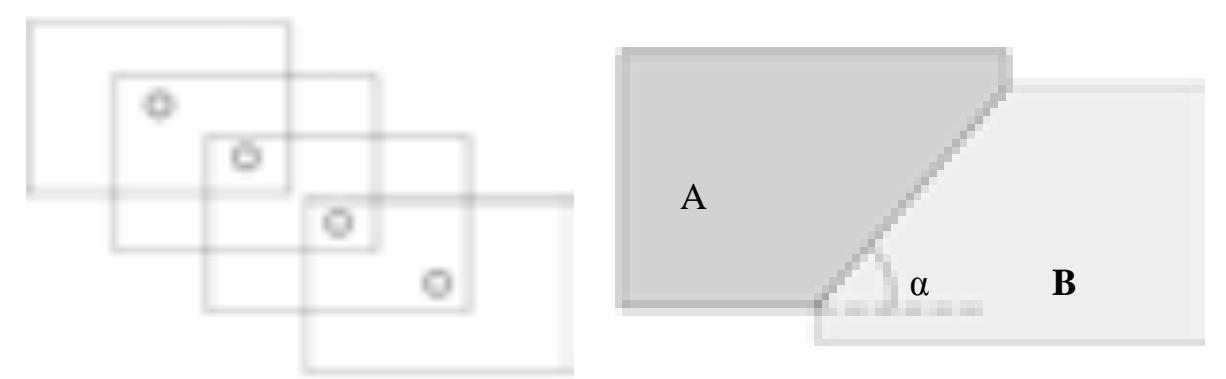
The first stage of the algorithm is expected to create a mosaic from the conclusion of a straight trajectory filmed video material. In the second stage of the algorithm to continuously improve the conclusion of a mosaic of different trajectories filmed video material. The final phase is planned to create program prototype with a different shot trajectories of seafloor video material.
The goal of presented research is to create the seafloor mosaic processing algorithms, dedicated to reduce the required time and cost of human resources and increase video frames quality.