
Terahertz (THz) radiation is in the frequency gap between the microwave and far infrared regions of the electromagnetic radiation spectrum. Terahertz sensing and imaging technology has been investigated in various fields, including security, medicine, biochemical applications. THz radiation offers a non-destructive and non-ionizing way of imaging and spectroscopy measurements. Recent work [1] has shown that THz waves can be used for material inspection and spectroscopy imaging.
In this work THz imaging set up and solid solar cell image in reflection geometry is presented. The THz imaging setup of the experiment is shown in (Fig. 1a). The main laser beam is divided by the beam splitter BS in two parts, where one travels to a parabolic mirror M1 and is focused on the reference detector D1. This signal is used to monitor the changes of radiation power of the THz laser. Other part of the beam is used to measure reflectivity of the sample. Off-axis parabolic mirrors M2 and M3 were used to focus the beam on the sample and collect reflected radiation. For low-noise signal detection beam was modulated with optical chopper. Detector signals were measured with synchronous amplifiers (lock-in).
We scanned the solar cell with defected contact to test our reflection system. THz image of the monocrystalline Si solar cell was recorded by moving the objected in XY plane. Scanning takes place while object is moved in direction X with the fast linear stage with a constant speed of 10 mm/s. Using this method image recording time depends on imaging area, sample translation velocity, speed of detection system and desired image resolution. The reflection image of solar cell taken with THz radiation of frequency 2.54 THz is shown in (Fig. 1c) while its visible light photo is in (Fig. 1b). Color scale of signal value shown on the right side of picture normalized in logarithmic scale. Total scanning time of area $90 \times 99 \text{ mm}^2$ with pixel size $0.3 \times 0.5 \text{ mm}^2$ was about 30 minutes.
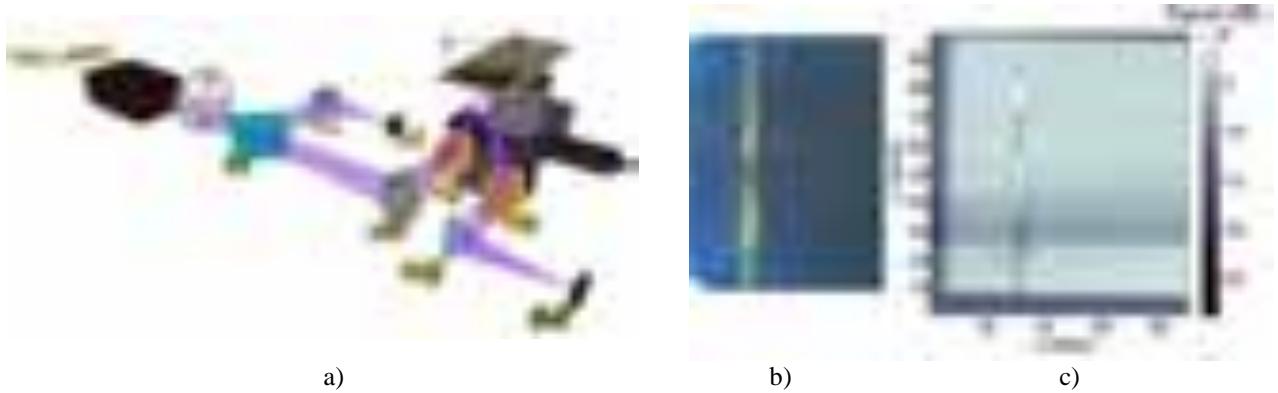
To summarize, in this work the THz imaging setup in reflection geometry was created and solar cell image with defected top contact at 2.54 THz was presented. We have shown that areas where the contact is bulged or otherwise damaged can be easily excluded from the image.