Solid-state lighting systems based on light emitting diodes (LED) become an important technology of general and niche lighting. One of the most attractive issues of this technology is a relatively high efficiency of light generation in LEDs in comparison to incandescent and fluorescent lamps. Nevertheless the major energy loss due to light conversion in a diode, the efficiency of power supplies are of high importance and has to be optimised [1].
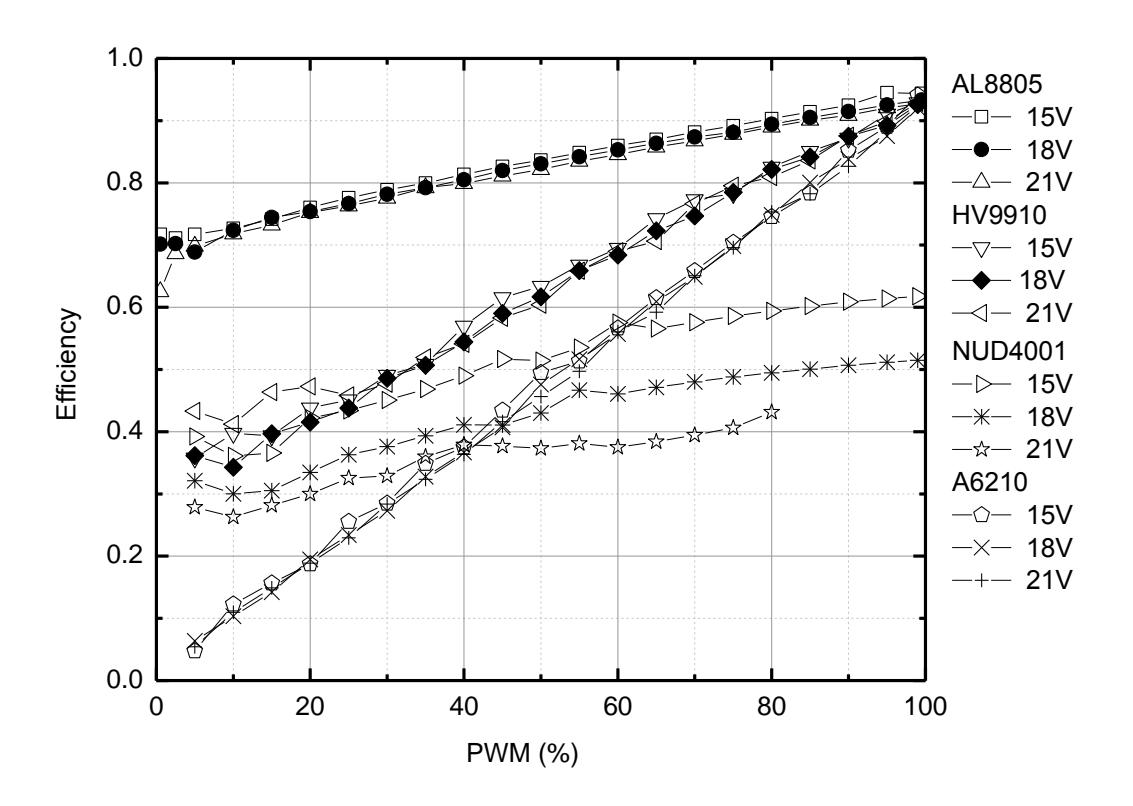
The goal of current research was to investigate the electronic circuits of the high-power LED driving supplies with the main focus into the efficiency, the dimming ability and the electromagnetic interference. Four different integrated circuits realized according to manufacturer recommendations were tested and their ability of handling the excess voltage was investigated in the range of 15 V to 21 V at 3 diodes load. The results showed that switch-mode power supplies coped with excess voltage easily end exhibited efficiency of at least 95%. Meanwhile linear current stabilizer was not so advanced and demonstrated energy efficiency value in the range of 40% to 60% depending on excess voltage. Furthermore the efficiency and the average output current were investigated as functions of the dimming factor realized by a pulse-width modulation (PWM) in the range of 1% to 99% of duty cycle. The results showed that using certain switch-mode power supplies acceptable efficiency and linear current characteristics can be obtained. Nevertheless during the investigation of internal and output signals the switch-mode power supplies exhibited undesirable high-frequency oscillations which should be considered seriously in order to fulfil the standards of the electromagnetic interference and emission.