During exploitation of nuclear reactors or after shutdown component activation analysis is required to ensure safety during activated components and used fuel transportation, decommissioning and storage. There are two ways determining activity and isotopic composition: physical measurement and computer modeling. Computer modeling can be deterministic (TRITON code from SCALE program package) or stochastic (MCNPX code [1]). Usually validation of computation can be done by comparing results with measurements or calculations using different computer codes. In this work calculations will be done using stochastic method with MCNP5 and MCNPX. This gives advantage to model complex structures, calculate mass fraction of isotopes and activities without need to work with radioactive samples or specific equipment, ability to calculate possible dose to human.
VVER reactor is Russian construction pressurized water reactor using water as moderator and coolant. VVER 440 unit maximum electrical power is 440 MW. Fuel assembly geometry is hexagonal with 126 fuel rods in assembly and up to 349 fuel assemblies inside core. For fuel cladding and assembly wall ZrNb alloy is used, most of the other reactor components are made of steel. Different enrichment UO2 fuel is used, possible enrichment: 1.6 %, 2.4%, 3.4%.
For accurate and fast calculations important parameters have to be determined [2]: fuel composition and burnup, which reactor components can be omitted from model or simplified, selection of important nuclides for activation calculation.
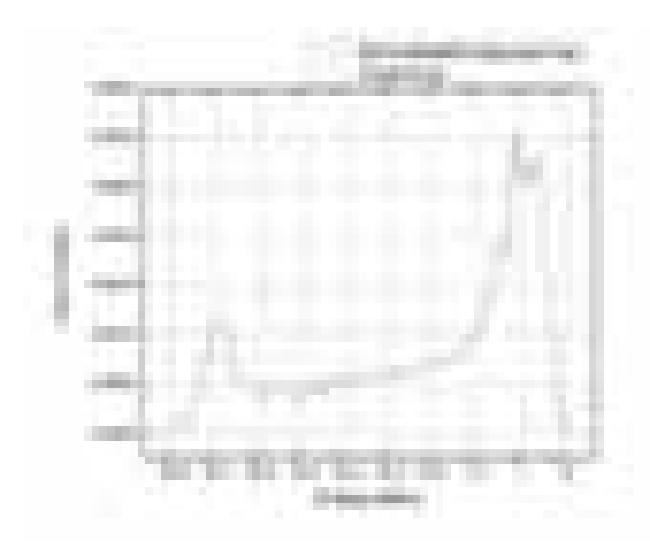
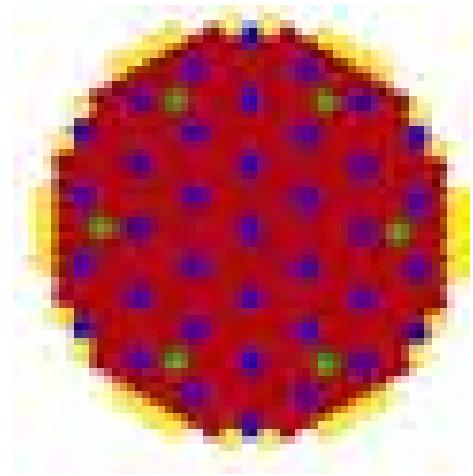
Reactor core fuel burnup and isotopic composition was calculated in order to load reactor model with different burnup fuel. Neutron flux differences in low energies can be visible (Fig. 1) and could play important role calculating activation of core surrounding components. For calculation one burnup step was selected 100 days and total burning time was 800 days, average burnup of fuel in VVER reactor is ~ 20 GWd/MTU, which is reached after 600 days of burning. One of the components which activity calculation will be conducted is dummy assembly. Dummy assembly is construction part used in the reactor core to replace fuel assembly for different core fuel loading patterns (Fig. 2). During long term reactor operation fuel burnup and loading varies, in calculations it was compared how flux and activation changes loading core with different burnup fuel.