New technologies of solid-state lighting and material science allowed discovering highly energetically productive AlInGaP red light-emitting diodes (LED's). However, phosphate layers in heterostructure lead to additional defects due to lattice mismatch with substrate [1]. The presence of defects leads to the trapping injected electron-hole pairs and their non-radiative recombination that increases leakage current and lowers efficiency of LED, also accelerates device degradation process.
Improvement in LED performance and reliability needs in-depth understanding the reasons of defect number growth, reasons of migration of defects during device aging, and how these processes affect operation characteristics and degradation of LED. Noise investigation gives valuable information and is useful for evaluating semiconductor device quality and predicting lifetime [2]. The aim of this work is to investigate noise characteristics of different type red light-emitting diodes, to clear up physical processes that take part in different parts of the LED and influence their degradation process during aging.
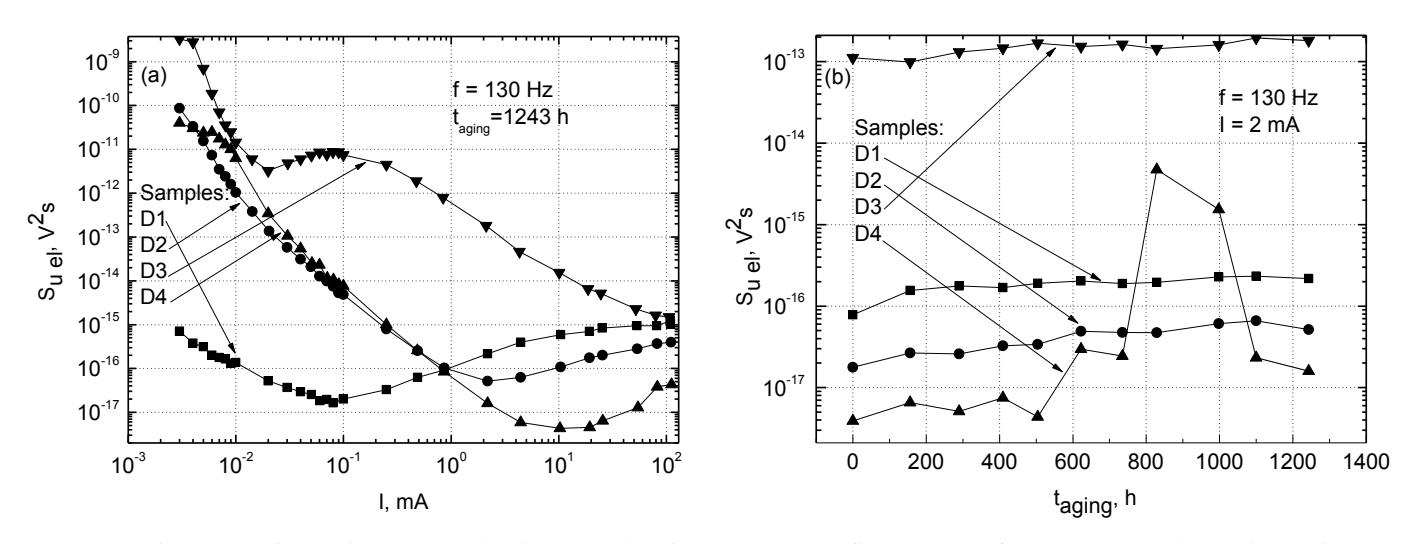
The experiment contained four LEDs of the same power (1W) and the same emitted wavelenght (643nm). The samples differ by the shape of lens: Phillips side-emmiting (D1), Lambertian (D2), Batwing (D3) and, for comparison, TME Lambertian (D4). Electrical noise spectral dencity of investigated LEDs is presented in Fig. 1. Experiment disclosed, that lens type does not make any effect on the level of noise of the investigated LEDs.
Examined noise characteristics revealed, that Phillips Batwing (D3) has the highest level of electrical noise (Fig. 1 (a)). Furthermore, D1, D2 and D3 electrical noise properties are growing slowly and steadily during the accelerated aging (by 300 mA forward current) experiment (Fig. 1 (b)). Although, TME Batwing (D4) electrical noise characteristics alter completely differently than of other samples'. During the first 500 hours of aging it showed very low level of electrical noise. But after reaching 850 hours of aging, noise spectral density increased very rapidly. Quick jump of the electrical noise spectral density may be determined by crystal lattice defects that might be generated by high current density or high temperature of p-n junction, both caused by aging by 300 mA forward current. Defects may create small leakage channels, that can alter current flow, so as non-radiative recombination processes in LED structure, that increases level of the electrical noise. Completing 1100-1300 hours of aging, D4 noise properties have restored because of defects migration in LEDs active layer. As a result, it proves unstable LED material quality and reveales that D4 can degrade much quicker than other samples.
Therefore, noise investigation is a prolific method to explore quality of any semiconductor device and evaluate its production and efficiency.