
In the past few decades zinc oxide (ZnO) has attracted much attention due to its unique properties, which are very desirable for applications in optoelectronic. ZnO is a direct band gap semiconductor with 3.4 eV band gap energy at room temperature and extremely high exiton binding energy (60 meV). Large exciton binding energy opens the possibility to make an excitonic stimulated emission (SE) based semiconductor laser (SL) with several advantages over regular SL. However, for applications in optoelectronic a stable, high, and reproducible p-doping is obligatory. Though progress has been made in this crucial field, this aspect still represents a major problem [1].
In this work, four ZnO epitaxial layer samples was investigated. SE effect was studied for different samples in order to characterize optical properties. Samples A and B were grown using metaloorganic chemical vapor deposition technique (MOCVD) on a (0001) plane sapphire substrate in Institute of Photonics and Optoelectronics of National Taiwan University. Samples C and D were grown using molecular beam epitaxy (MBE) technique on a ($11\overline{2}0$) plane sapphire substrate in Virginia Commonwealth University [2]. The epitaxial layers were optically excited using frequency tripled ($\lambda_{\text{exc}} = 355$ nm) and quadrupled ($\lambda_{\text{exc}} = 266$ nm) pulsed YAG:Nd3+ laser beam. The pulse duration was 4 ns and repetition rate was 10 Hz. The variable stripe length technique was employed for optical gain measurements [3]. The excitation beam was focused on the sample surface using cylindrical lens to create a narrow excitation stripe of 30 μm and 25 μm in width for frequency quadrupled and tripled excitations, respectively. Edge photoluminescence (PL) dependency on excited stripe length l was measured by partially screening the sample with a metal plate. PL signal was collected to a double monochromator of 0.6 m focal length and registered using a photomultiplier tube. The PL was measured utilizing boxcar integrator in quasistationary excitation regime.
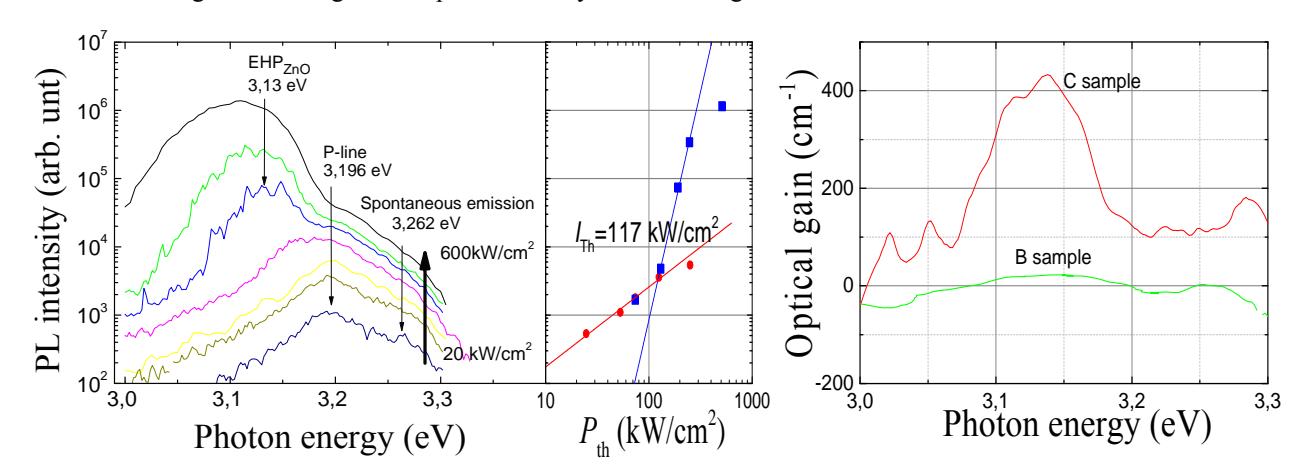
In Fig. 1, the PL spectra dependence on excitation power density $P_{\text{exc}}$ is shown. Three spectral lines can be identified namely, spontaneous emission line at 3.262 eV, exciton-exciton radiative interaction PL line (P-line) at 3.196 eV, and electron-hole plasma (EHP) induced SE line at 3.130 eV, which appears at elevated $P_{\text{exc}}$. The SE threshold was indicated from integrated PL intensity dependence on $P_{\text{exc}}$ in double-logarithmic scale (Fig. 1. inset). The lowest SE threshold $P_{\text{th}} = 105 \, {\rm kW/cm^2}$ was measured for sample D and the highest $P_{\text{th}} = 522 \, {\rm kW/cm^2}$ was measured for sample B.
The optical gain coefficient (OGC) spectra were obtained by analyzing the measured edge PL spectra. The optical gain spectra dependence on l and $P_{\text{exc}}$ was investigated. The saturation process occurs at high l or/and $P_{\text{exc}}$ values and reduces the actual OGC of the medium. Therefore the optimal experimental conditions has to be ensure for OGC measurements. The maximum OGC measured in the experiment was 400 cm-1 for sample C (Fig. 2). In contrast, very low OGC of around 5 cm-1 was measured for sample B. This indicates the much better optical and crystal qualities of MOCVD grown ZnO epitaxial layers.