
Recent approaches that introduced nanometer scale multilayer heterostructures made possible artificial semiconductors with outstanding properties. They open new opportunities for applications of semiconductor devices, such as bright light-emitting diodes, laser diodes, tandem solar cells and other. Together with ongoing progress on wide-gap semiconductors, the optical wavelengths accessible by semiconductor devices are steadily expanding towards the short-wavelength ultra-violet, as well as further into the far-infrared and terahertz spectral regions [1]. The multiple-quantum-wells (MQWs) and super-lattices are the main heterostructures for most of contemporary optoelectronic devices. In order to better understand and apply such heterostructures the carrier transition effects need to be studied and well described.
In this work we present the model of photoexcited carrier dynamics. Using this model time-resolved photoluminescence (PL) decay in MQWs is described and compared with experimental data. The model of excess carrier dynamics is conducted using one-dimensional continuity equation [2] assuming that photo-generation of carriers takes place only in quantum wells, they are not captured from the barriers or do not escape to the barriers. Therefore, we assume that carriers prior to the recombination can laterally diffuse in quantum well or be captured in quantum-well/barrier interface states. The model takes into account the reabsorption of emitted light. However, we consider that such effect is not significant and can be neglected. In order to compare results with measured PL dynamics, carrier density was integrated by the quantum well length at different delay time [3].
The experiment of time-resolved PL was carried out two types of MQWs. The InGaN/GaN samples consisted of 5 MQWs and CdZnO/ZnO samples consisted of 3 or 10 MQWs. The samples were grown using molecular beam epitaxy technique in National Taiwan University. The streak camera (Hamamatsu, C5860) was used for spatial and temporal PL registration. The samples were excited using frequency doubled laser beam of femtosecond Ti:sapphire laser (Coherent, Mira 900) with the repetition rate $f_{\text{rep}} = 76$ MHz and pulse duration $\tau_p = 150$ fs. The excitation wavelength was $\lambda_{\text{exc}} = 390$ nm resulting the selective excitation of MQWs.
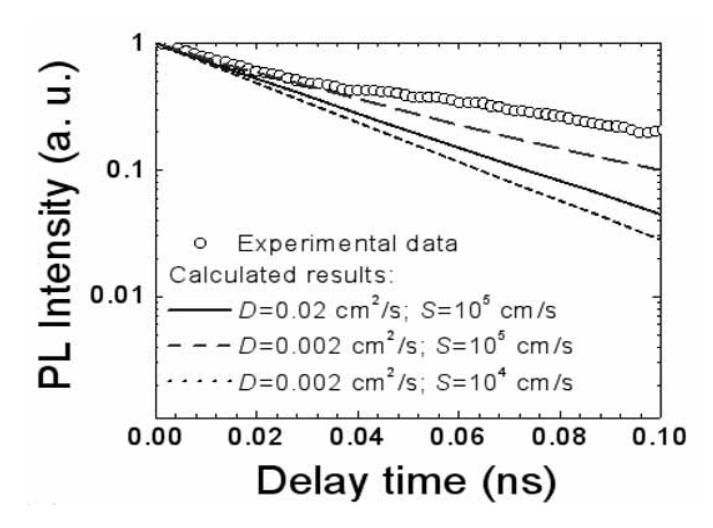
As shown in Fig. 1, the fitting of the calculated results with the experimental data achieved good agreement. Since the measured PL decay was two exponential, the fitting was preformed on the faster PL decay component taking into account the PL intensity range from $I_{\text{max}}$ to $I = I_{\text{max}}/\text{e}$. The PL decay time of CdZnO/ZnO MQWs was measured as 60 ps. The model yields the diffusion coefficient D = 0.002 cm2/s and surface recombination rate S = 105 cm/s. As a result, the surface recombination plays significant role in PL decay in MQWs due to repetition of quantum-well/barrier interfaces. To sum up, the InGaN/GaN MQWs have better radiative properties due to better quality of the structure.