
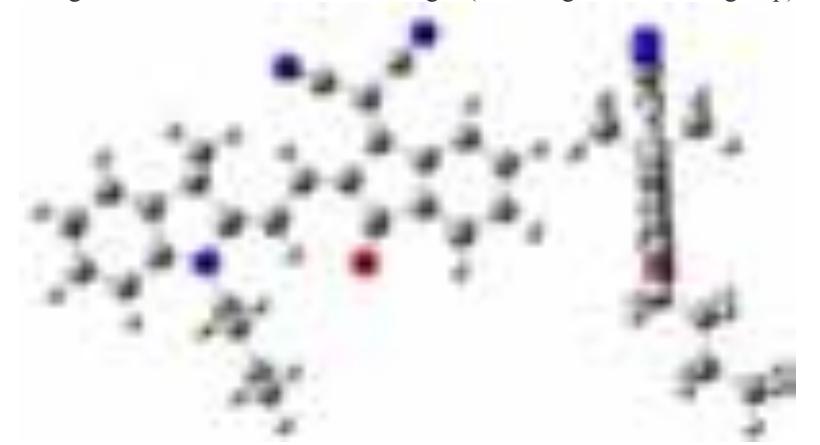
Quantum chemistry calculations have been provided for ground state optimization of compound MD376 (neutral, see Fig. 1, also cationic, anionic) using ab-initio Hartree-Fock (HF) methods (Gaussian03 package). Optical absorption spectrum distribution (in the near UV and visible area) of MD376 solution was explained according to the results of the optimized geometry, taking into account the fact that the MD376 compound represents an behavior of neutral, cationic and anionic forms[1-2]. Estimated molecular charge redistribution during the optical excitation was related to the recombination of structural fragments as conformational exchanges (CC bridge and diciano group).
Simulation of several MD376 dimeric forms (when two molecules overlaps by indan-(1-diciano) dione fragments) allows us to claim that dimer derivatives create the environmental conditions for two-sided perturbation only. Electronic absorption states of individual molecules and dimer molecules are almost identical (according to Ref. [3]).