The synthesis of the iron oxide particles have been a field intense study due to the novel properties and potentiality on the practical applications to ferrofluids [1], high density magnetic recording and microwave devices [2]. Various preparation techniques, such as sol-gel method, chemical precipitation [3] and mechanical alloying [4] are used to produce ferrite nanoparticles.
In this study iron oxide nanocomposites were synthesized by high energy ball milling of iron(II) sulfate, iron(III) hidroxide – sulfate and sodium hidroxide. The synthesis equation was:
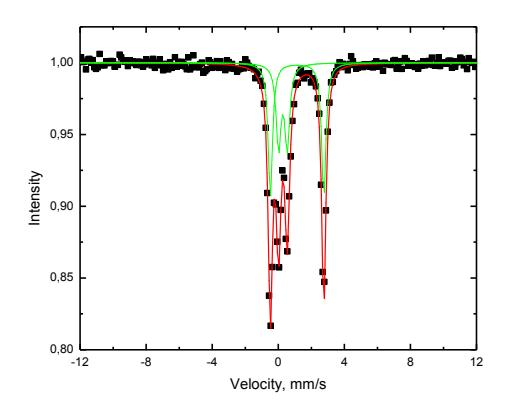
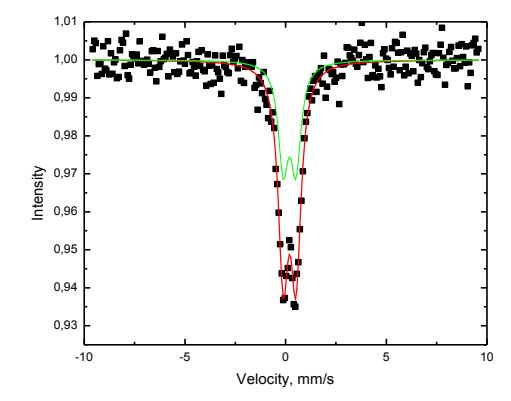
$$FeSO_4 + 2Fe(OH)SO_4 + 6NaOH \rightarrow Fe_3O_4 + 3Na_2SO_4 + 4H_2O\tag{1}$$The physical parameters governing the milling process have been strictly controlled so as to achieve the results. Samples were taken after different synthesis time. It was determined, that black precipitates formed faster than 15 minutes of milling (Fig. 1,2.). According to Mossbauer sprectroscopy measurements in 13 K temperature, the synthesized iron oxide nanoparticles were similar to magnetite ($Fe_3O_4$), which have feromagnetic properties. From XRD measurements it was found that the magnetite formed during mechanical milling. In room temperature Mossbauer spectra shows paramagnetic characteristics, which can be related to very small (<10 nm) magnetite particles. Particles size were studied by X-ray diffraction, which shows that after 8 h of milling formed about 5 nm particles. It was also determined, that planetary mill wears out, because the fraction of iron was detected in samples. Mossbauer results also showed, that the chemical composition of samples does not depend on milling time.