
Keratin - fibrous structural protein, is the main component of human hair. Analysis of its distribution along the hair fiber allows determining its distance from the root, a degree of pigmentation and human origin. Testing of human hair fibers is an essential study in forensic science and its results may be the clear evidence presented in the court [1].
Fourier transform infrared spectroscopy (FTIR) is an excellent tool for morphological analysis of human hair. Microscope Hyperion 3000 combined with the spectrometer Vertex 70 from “Bruker” was used in this experiment. Untreated, blond and dark (homogenous) hair strands were collected from European origin 15 and 13 year-old females. The samples were flattened by applying a pressure of 10 tons on them, placed on CaF2 (calcium fluoride) optical window and absorbance spectra were recorded. Firstly, the spectrum of blond hair at the centre of the fiber was obtained. The spectrum of amino acid - cysteine consists from strong amide I band at 1650 cm-1, amide II band at 1540 cm-1, NH stretch bands at 3290 cm-1 and 3060 cm-1, medium intensity CH stretch bands at 2963 cm-1, 2931 cm-1 and 2875 cm-1. Nucleic acid (amide III) band was also observed at 1238 cm-1. After washing the hair with liquid soap, no major spectral differences were detected. Secondly, dark hair strand's root, centre and tip were analyzed.
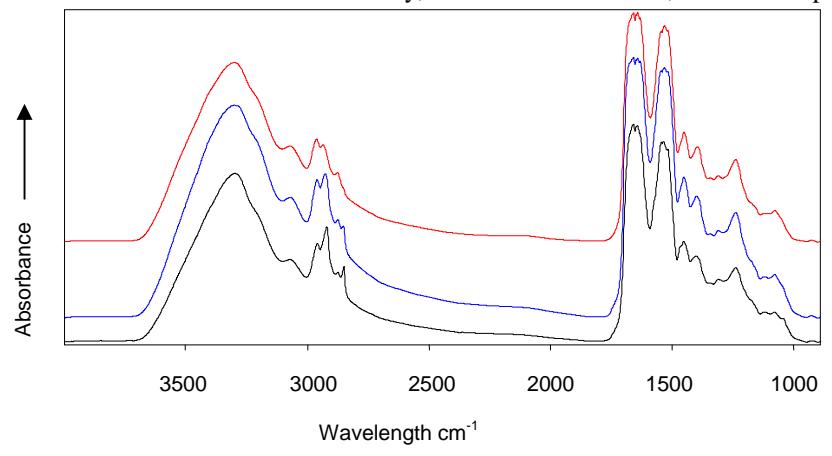
As shown in the figure 1, the hair composition along the hair strand slightly changes. An intense CH2 stretch band is observed at 2920 cm-1 and 2850 cm-1 in the spectrum of the hair tip. These bands are observed in the spectrum of the medulla – inner part of the hair fiber [2]. This implies that hair strand decreases in diameter due to degradation of the cuticle – the outermost part of the hair fiber, and is the thinnest at the tip. Less intense 2920 cm-1 and 2850 cm-1 spectral bands are also observed in the spectrum of the hair strand's centre. This suggests gradient decrease in diameter.
Another important spectral band which emerges in hair tip's spectrum is seen at 1040 cm-1, which indicates about increase of cysteic acid concentration. Cysteic acid is a product of oxidation process which occurs as a result of UV radiation. As the tip of the fiber has been affected by this process for a longer time the concentration of cysteic acid is higher in it. However, there were no major differences between dark and blond hair spectrum detected.
In conclusion, the results of infrared microscpectroscopical analysis show that the chemistry of the hair fiber changes from root to tip. These changes are caused by oxidation as well as cuticle degradation. A grey hair will also be morphologically analyzed, thus we will compare it with the investigated ones. The difference in degree of pigmentation is expected. We will also analyze a hair sample of drug addict, particularly cannabis user. Thus more detailed information will be presented.