
The precise control of optical properties such as refractive index or absorption coefficient is essential in optical technologies. There exist several optical metrology techniques that enable determination of optical constants and critical dimensions, i.e. refractometry, spectroscopic ellipsometry, scatterometry, evanescent wave sensors [1], etc. As it was demonstrated previously [1] spectral analysis of polarized light reflected from the diffraction grating enables determination of the dielectric function of the material in vicinity of the grating surface. In order to achieve better accuracy and repeatability of the measurements a motorized goniometric stage with automated spectra acquisition was designed and fabricated. The setup can be employed in angular reflectance or transmittance measurement configurations covering polarized visible wavelength range light. In this work possible application of the measurement setup for determination of the Brewster angle is presented.
Measurement setup consisted of a white light source (incandescent light bulb), collimating optics (three fused silica lenses), a Glan-Taylor polarizing prism on motorized rotational stage and motorized sample/detector goniometric stage (full step resolution 0.6 arcmin, Standa). The reflected light was coupled to the optical fiber via a quartz lens and the spectra were measured with AvaSpec-2048 spectrometer (spectral range: 360-860 nm, resolution 1.2 nm, Avantes). The angular polarized light reflection spectra measurements from fused silica and indium tin oxide (ITO, Sigma Aldrich) were performed (see Fig. 1 a, b). Experimental results were compared with theoretical calculations obtained employing equations (1) and (2) [2, 3]:
$$R_{p} = \left| \frac{-n^{2} \cos \theta + \sqrt{n^{2} - \sin^{2} \theta}}{n^{2} \cos \theta + \sqrt{n^{2} - \sin^{2} \theta}} \right|^{2}\tag{1}$$$$R_{s} = \left| \frac{\cos \theta - \sqrt{n^{2} - \sin^{2} \theta}}{\cos \theta + \sqrt{n^{2} - \sin^{2} \theta}} \right|^{2}\tag{2}$$where $R_P$ and $R_S$ are reflection coefficients for s and p polarizations respectively, $n$ refractive index of the specimen, $\theta$ angle of incidence.
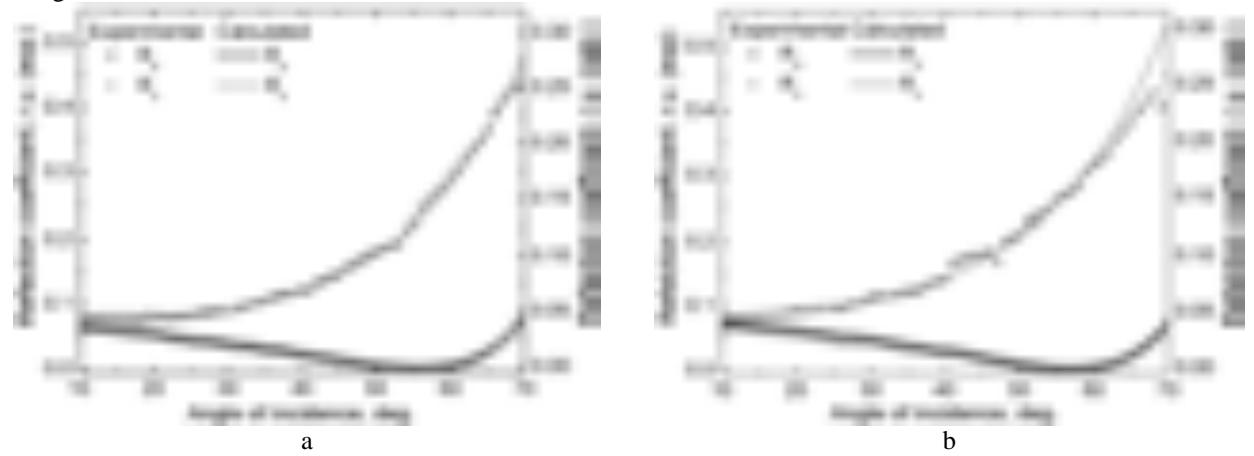
We have demonstrated that the experimental setup is suitable for angular reflectance measurements covering polarized visible wavelength range light. From the experimental results we have estimated the Brewster's angle for fused silica - 55.92° and ITO - 57.13° that are in good agreement with theoretical (calculated) results - 55.55° and 56.57° respectively.