
Semiconductor nanoparticles known as quantum dots (QD) are very promising in biomedical apllications due to their unique photophysical properties such as wide absorption and narrow emission bands. In order to use QD for cellular visualization and cancer treatment including drug delivery systems, it is vital to understand the fundamental mechanisms of their entrance and trafficking within cells. Before this could be done, QD surface has to be modified using specific ligands in order to make them hydrophilic and able to pass through cell membrane. After modification of QD surface with different thiols we observed that mercaptorpopionic acid (MPA) is most suitable for QD surface modification. In previous works [1] it is shown that the best QD surface ligand is QD-MPA retains high colloidal stability and good optical properties. We also showed that QD-MPA enter cells by endocytotic pathway but does not affect cells viability. However if we want to use quantum dots as nanoplatform for drug delivery additional information is needed.
The goal of our study was to investigate how QD and their phallotoxin conjugates accumulate in mouse embryo fibroblast cells (NIH3T3) by using fluorescence confocal microscopy. Phalloidin was selected as phallotoxin which is isolated from the deadly Amanita phalloides mushroom and is commonly used in imaging applications to selectively label F-actin in fixed cells, permeabilized cells, and cell-free experiments. Therefore, this dye does not work on living, nonfixed cells and do not pass the cell membrane. In this work, we used QD-MPA with 625 nm emission band and Alexa Fluor 488 Phalloidin conjugate with 488 nm emission band. QD-MPA and phalloidin was mixed together to create one conjugate in order to investigate if QD can be used as drug carriers.
As shown in Fig. 1A,B QD-MPA and QD-MPA-phalloidin conjugates successfully accumulate in NIH3T3 cells after 24h of incubation. However, QD-MPA accumulate only in late endosomes while QD-MPA-phalloidin conjugates pass into cell and separately Alexa Fluor 488 Phalloidin conjugate labels actin filaments and QD pass to cell nucleus.
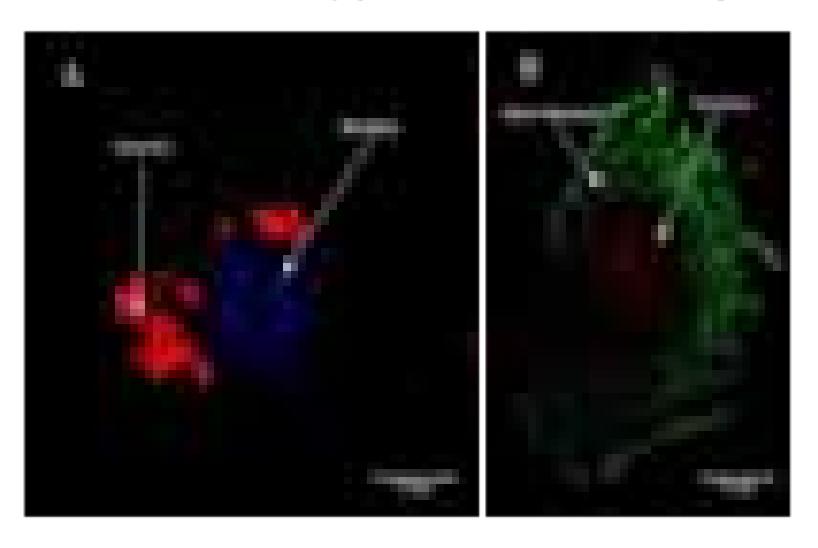
These results show that QD-MPA can be used as phalotoxin delivery system. Although, QD-MPA accumulation in cell nucleus suggests that phalotoxins affect cell viability and inner processes which results in the change of nucleus membrane permeability. All in all, this phallotoxin delivery system is a great breakthrough in creating an universal QD based drug delivery systems which will change the modern medicine as we know it and greatly improves cancer treatment.