
The power-law of spectra of signals, including 1/f noise (also known as 1/f fluctuations, flicker noise or pink noise) is common in both physics and other fields (computer networks, financial markets). This subject has been a hot research topic for many decades [1]. 1/f noise received a growing interest in biology, psychology, and movement sciences during the last decade. For example, 1/f fluctuations are generally evidenced in young and healthy systems, performing in a stable, unperturbed environment, and facing easy or over learned tasks. In contrast, 1/f fluctuations seems to disappear with aging or disease. So, there is a close relationship between health and 1/f noise [2].
We analyzed a model based on signal I(t) that is a superposition of stochastic processes
$$I(t) = \sum_{l=1}^{N} I_l(t), \tag{1}$$where N is a number of processes and $I_l(t)$ is stochastic process described by the Langevin equation
$$\dot{I}_l = -\gamma_l I_l + \sigma \xi(t). \tag{2}$$Here $\gamma_l$ is relaxation rate of process $I_l(t)$, $\xi(t)$ is a white noise and $\sigma$ is standard deviation of white noise.
We assume that relaxation rates $\gamma_l$ value is restricted in interval $[\gamma_1, \gamma_2]$ and $\gamma_l$ are distributed according to power-law, $P(\gamma_l) \sim \gamma_l^{-\eta}$. Where $\gamma_1$ and $\gamma_2$ are minimal and maximal values of the relaxation rates.
The correlation function of signal I(t) is
$$C(s) = \left(\frac{1-\eta}{\gamma_2^2}\right)^2 \frac{1}{\sin(\pi\eta)} \frac{1}{s^{1-2\eta}}, 0 < \eta < 0.5, \gamma_2^{-1} << s << \gamma_1^{-1}. \tag{3}$$The power spectral density of signal I(t) is
$$S(f) = \frac{1}{(2\pi)^{2\eta}} \left( \frac{1-\eta}{\gamma_2^2} \frac{\pi\sqrt{2}}{\sin(\pi\eta/2)} \right)^2 \frac{1}{f^{2\eta}}, 0 < \eta < 0.5, \gamma_1 << f << \gamma_2. \tag{4}$$If the stochastic process exhibit spectral density proportional $1/f^{\alpha}$ and exponent $\alpha$ varies between 0 and 1, then it is called long-memory process [3].
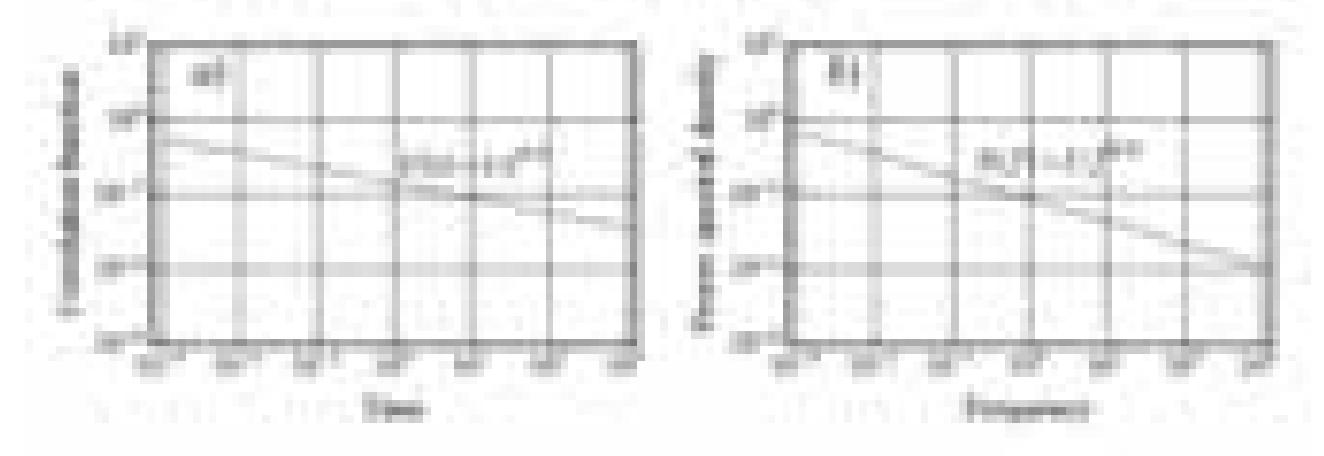
Model generated power spectral density as function of frequency is presented in figure 1. We proved that the model in specific frequency range $\gamma_1 \ll f \ll \gamma_2$ generate spectral density proportional $1/f^{\alpha}$. It means that superposition of earlier mentioned processes exhibits 1/f fluctuations with long-memory.