
Pb(Mg1/3Nb2/3)O3 (PMN) is one of the most known, classical ferroelectric relaxors (FR). At room temperature PMN has cubic ABO3 perovskite structure, where Pb2+ occupies A-sites while Mg2+ and Nb5+ share B-sites. The chemically ordered regions (CORs) as well as the polar nanoregions (PNRS) – small nanometer-sized uniformly polarized regions, which persist at temperatures well above the temperature of the dielectric constant maximum $T_m$ are often believed to be the origin of the characteristic relaxor ferroelectric behavior. Such behavior was observed only in those compounds where the nanometre-scale CORs are present. Accordingly, it was suggested that CORs act as sites to localize the dynamic PNRs responsible for the relaxor behavior. In pure PMN, the size of the CORs was found to be smaller than 5 nm. A-site La3+-doping has been found to be an effective way to enhance B-site cation order in PMN [1]. In 0.98Pb(Mg1/3Nb2/3)O3 – 0.02La(Mg2/3Nb1/3)O3 (PLMN) crystal there are marked decreases in the value of the maximum of relative permittivity, the temperature of peak permittivity and the freezing temperature [1]. However, it is not clear how the CORs affect the dynamics of PNRs. Thus the investigation of broadband dielectric properties of (PLMN) crystal promotes the deeper understanding of the mechanisms of relaxor behavior and PNRs dynamics.
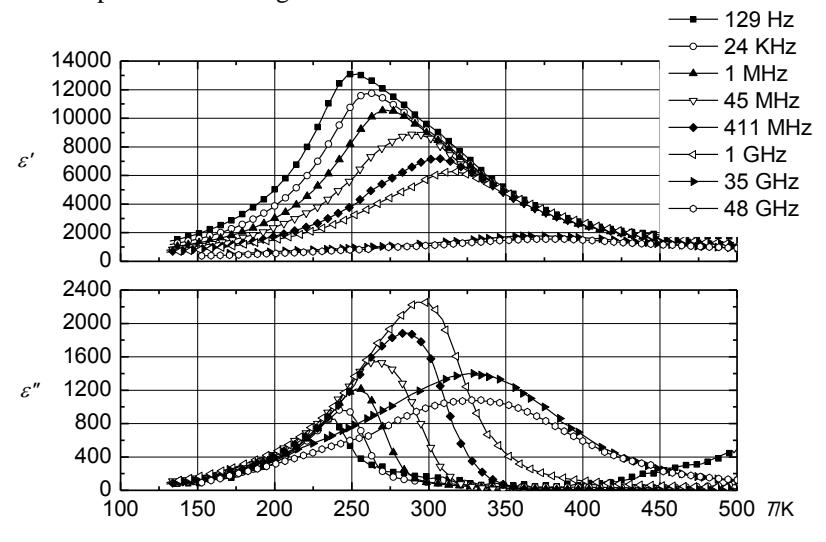
The dielectric properties of PLMN crystal were observed in frequency range of 100 Hz – 48 GHz and in temperature range of 110 K – 500 K. The sample was heated to 500 K temperature in order to eliminate “memory effects" – dissarange "frozen” PNRs. The measurements of dielectric permittivity took part in freezing cycle with 1 K/min temperature drop rate. Fig. 1 shows the temperature dependency of complex dielectric permittivity. The peak of $\varepsilon'(T)$ goes towards higher temperatures with increase of frequency. This is common behavior of FR and is caused by the broad distribution of PNR relaxation times. The dispersion of complex dielectric permittivity $\varepsilon^*(f)$ was fitted with Cole – Cole (1) formula, which describes the conventional relaxation process rather well. Although, another dispersion was found in frequencies $f < 1$ kHz, which requires further investigations.
$$\varepsilon^*(\omega) - \varepsilon_{\infty} = \frac{\Delta\varepsilon}{1 + (i\omega\tau)^{1-\alpha}}\tag{1}$$The temperature dependency of mean relaxation time $\tau$, which was obtained from Cole – Cole fits, increases with decrease of temperature. The increase is non-linear even in logarithmic scale and it can be described with Vogel – Fulcher formula (2). Such behavior shows that the dynamics of the system slow down with decrease of temperature and slow down critically at temperature $T_f= 191$ K.
$$\tau(T) = \tau_0 \exp\left(\frac{E}{k(T - T_f)}\right)\tag{2}$$