
The pulses at 1.3 μm have a great number of applications in various technical, technological and scientific applications. In present, many different laser materials are used, including Nd:KGW, Nd:YAG, Ng:GdVO4. Several saturable absorbers such as semiconductor saturable absorber mirrors (SESAM), Co2+-doped crystals, V3+-doped crystals are employed as passive Q-switches. Crystals of V3+:YAG have attracted great interest due to their excellent physical and optical performance at 1.34 μm, namely high ground state absorption cross-section, low density of saturation energy, high damage threshold. It makes them very attractive not only for effective passive Q-switched regime, but also for Q-switched mode locked (QML) regime applications. At that moment theoretical modeling for QML is done with the use of time-dependent spatially-concentrated model. Following model makes impossible to study pulse evolution dynamics and eliminates possibility of parametric optimization.
In previous paper [1] a time-space distributed model was introduced for laser which operated in continuous-wave regime. A range of microchip laser medium parameters that allows achieving optimal output parameters was considered in [2]. In this work a similar model is used to simulate QML regime in Nd:GdVO4 laser with V3+ :YAG saturable absorber. Two goals are pointed out. The first one is to obtain the dynamics of the laser pulse formation. The second one is to determine influence of the resonator geometry and influence of additional reflection (at the end of medium rod) on lasing. The system solved is as follows:
$$ \frac{1}{c}\frac{\partial I_{gen}^{\pm}}{\partial t} \pm \frac{\partial I_{gen}^{\pm}}{\partial x} = (\gamma_1 n_1 + \gamma_3)I_{gen}^{\pm} + \delta \frac{1}{\tau} n_2 N_0 \hbar v_{gen} L_{med} + \gamma_3 \Delta_1 (1 - y) \Delta_2 y I_{gen}^{\pm}; \tag{1} $$ $$ \frac{dy}{dt} = \theta_3(1 - y) - \left(I_{gen}^+ + I_{gen}^-\right)y\theta_1; \quad \frac{dn}{dt} = (1 - n_2)I_0\alpha_1 - \alpha_2\left(I_{gen}^+ + I_{gen}^-\right)n_2 - n_2\alpha_3. \tag{2} $$Where $I_{gen}^{\pm}$ stands for lasing intensity, $I_0$ for pump intensity, y for density of the ground states of saturable absorber related to saturable absorber concentration, $n_2$ for density of the exited neodim ions related to overall concentration. This system is solved numerically by the means of finite-difference scheme [3]. The simulation result is on fig. 1
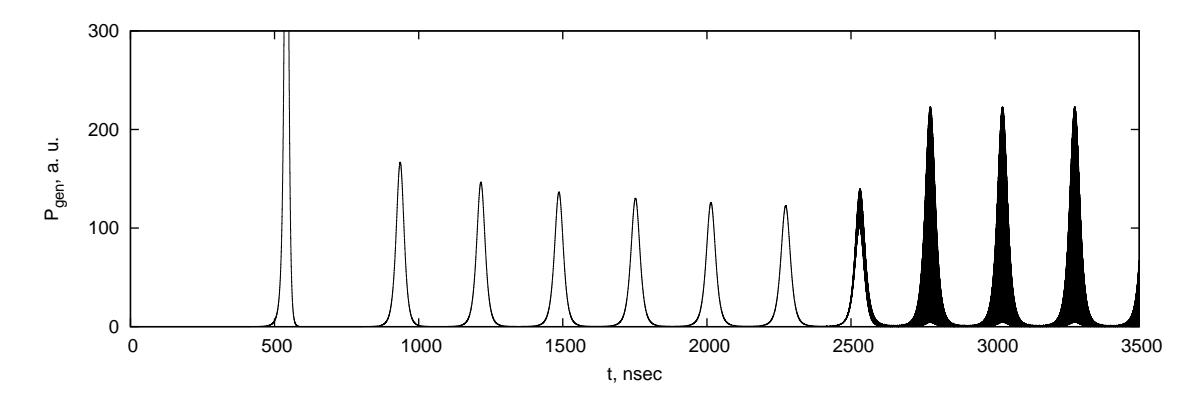
This figure illustrates the process of the pulse train formation dynamics in the case, when there are no gaps between input mirror, medium, saturable absorber and output mirror. One can see, that the first pulse is the most powerful, consequent pulses gradually transform to a broad pulse with high-frequency modulated structure.
Finally, the process of the pulse train forming was considered at different parameters, namely resonator length and the position of saturable absorber. Obtained results open a possibility of parametric optimization of dynamical characteristics.