Optical storage is an important area for information technologies. Already lots of materials have been investigated, however, the effectiveness and rewritable qualities remain serious issues for the development. The breakthrough of organic optoelectronics gives a good chance for polymers to be developed applied as storage material. Still people from organic synthesis have ideas for creating new interesting materials, in particular, also for optical storage applications.
All-optical poling is a good experiment to investigate optical storage features of the material. The task is to create noncentrosymmetry in optically isotropic material and as a result to observe second order nonlinear optical effect. This work presents all-optical poling and relaxation processes of azophenylcarbazole chromophore doped into polycarbonate matrix forming guest-host system. The beam source was nanosecond Nd:YAG laser operating at the wavelength of 1064 nm. Noncentrosymmetry is created mixing first (${\omega}$) and second ($2{\omega}$) harmonic beams of laser in the material.
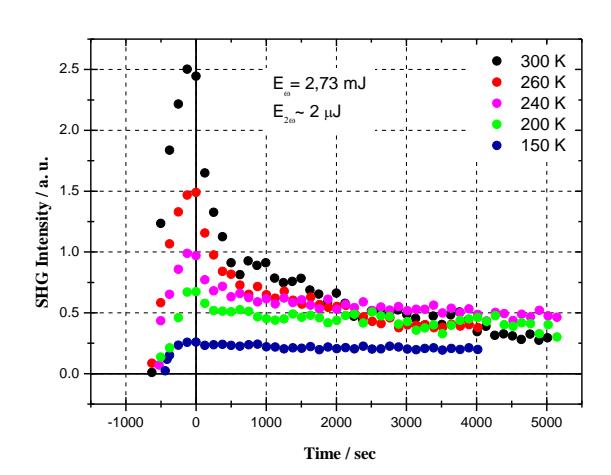
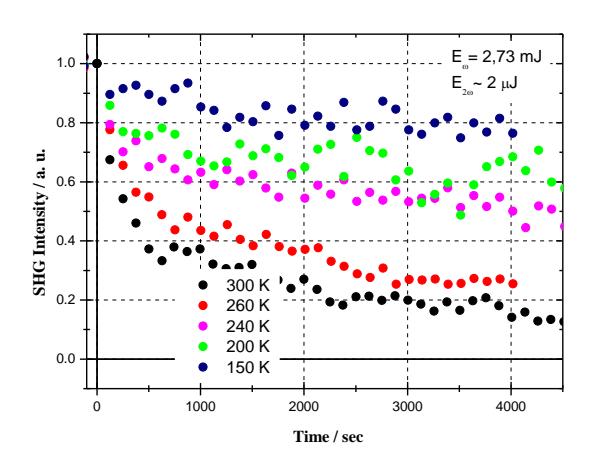
New in our work is the temperature dependence of all-optical poling. The poling efficiency decreased when decreasing the temperature of the sample (temperature was changed from 150 K to 300 K). However, main result expected was a decrease of relaxation speed, when decreasing the temperature (Figs. 1 and 2). This very important result for optical storage applications will be presented and discussed.