
The main obstacle in applying laser processing technology in specific applications such as glass cutting are the debris [1] and micro-crack formation [2]. Cracking, chipping and laser induced thermal effects could lead to the degradation of the mechanical and bending strength of the glass.
Some studies have shown increased ablation quality and efficiency in underwater or water-assisted laser machining [3]. The effect of water in laser processing mostly consists of conversion of part of the light energy to mechanical impulse, which transports debris, nano-particles away from the working area, cools the workpiece more effectively than gases. Usage of water may cause useful chemical reactions with material surface and reduce atmospheric pollution by waste gases and aerosols [4].
Solid-state Nd:YVO4 laser with picosecond pulse duration (100 kHz rate and 1064 nm wavelength) together with airbrush spraying water mist on sample surface were used in the experiments. Soda-lime-silica glass plates of thickness of 1.3 mm where used as the samples.
In the experiments trenches on glass surface were scribed by changing laser scanning speed, laser power and angle of airbrush which sprayed water mist forming thin water film on glass surface. Scribes were done in two regimes: laser processing in ambient air and using airbrush.
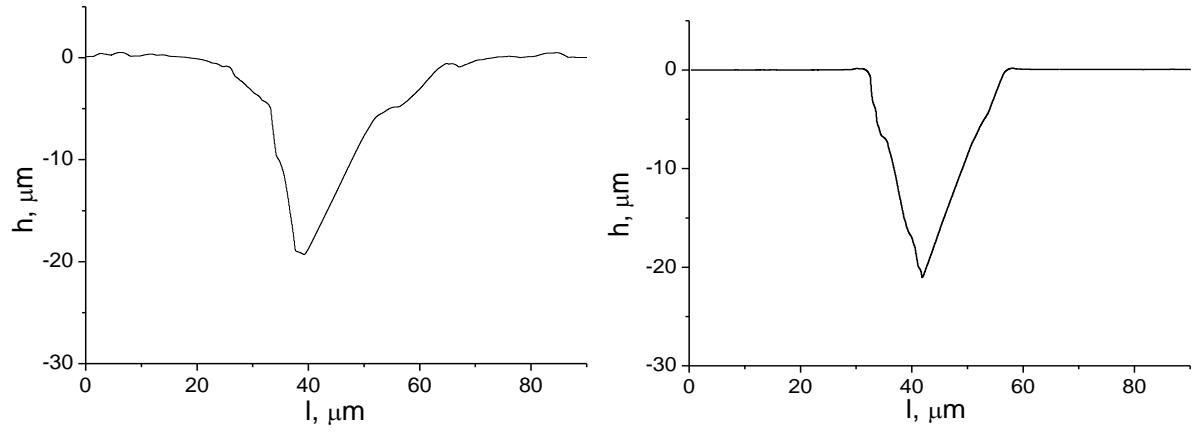
Optimization of water spray system was performed. Optimal parameters such as aerograph inclination angle and nozzle distance from the surface were defined. Further, the ablation thresholds of glass were measured for water assisted ablation and in ambient air. Line scribing experiments were also realized. For the scribing speeds lower than 32 mm/s water assisted processing enabled to increase the h depth and reduce the l width of the trenches compared to processed in ambient air (Fig. 1).
Water assistance in glass cutting applications is a perspective technology and able to increase the ablation rate and optimize the cutting process.