The lack of available radio frequency (RF) bands leads to a solution for allowance of spectrum sharing between different communications systems. Such an example is radio local area network systems (RLAN) that operate at 5 GHz frequency band which is also used by many radar systems. The problem that occurs is that the interference between these systems becomes probable and may seriously damage the output data of radar systems. For this reason European Telecommunications Standards Institute (ETSI) has released a standard, known as ETSI EN 301 893 [1], which says that manufacturers of RLAN devices must employ the dynamic frequency selection (DFS) mechanism in order to protect radar systems. RLAN designers have to ensure the employed DFS is working properly, and a way to do that is to test RLAN devices by nearby generating radar test signal which properties are defined by ETSI standard. The task of our work was to investigate the parameters of radar test signals defined by ETSI and to create a radar signals generator as a testing device.
The DFS mechanism is necessary when RLAN devices operate at frequencies between 5250 and 5350 MHz or 5470 and 5725 MHz. In these ranges RLAN devices must detect the radar signal, stop the operation and switch to another frequency band and start the data transfer if the band is clear. According to the standard there are six types of radar signals which RLAN device must detect: 1-3rd type is a constant pulse repetition frequency signal, 4th type is a constant pulse repetition frequency signal with variable frequency modulation, 5-6th type is a staggered pulse repetition frequency signal [2]. All these types of signals differ in their pulse widths, lengths, structures, etc.
To create, realize and generate the radar test signal we chose to use the software defined radio (SDR) platform. The software part we used was the GNU Radio packet loaded on Ubuntu operational system. The hardware part was the low-cost universal software radio peripheral 2 (USRP2). Emulated signals were analyzed with Rohde & Schwarz FSH8 spectrum analyzer. The program code was written by adding the necessary syntax into the one particular GNU Radio software block. This block was useful cause of its capabilities to quickly and comfortably connect to the USRP2 device and generate a specific signal which parameters were defined in one command line.
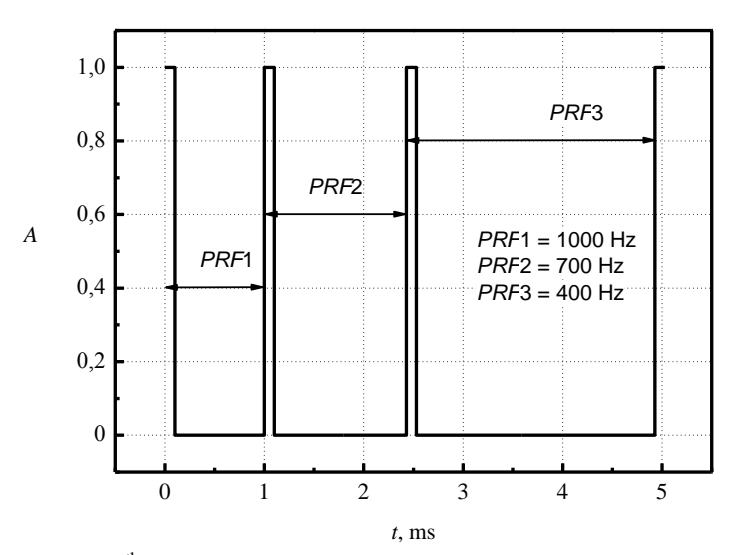
During the time of our task we have analyzed ETSI standards and successfully prepared a program which was able to generate the 1-3rd and 5-6th type radar signals using USRP2. Fig. 1 shows the generated form of 5th type radar signal. Emulated signals were studied using spectrum analyzer and their correspondence to the standards was proven. The 4th type signal with variable frequency modulation was not implemented in our main software, but its mathematical model was made using MATLAB.