1 Vilnius University, Physics Faculty, Department of Quantum Electronics, Laser Research Center, Saulėtekio al. 10, LT-10223 Vilnius
Concerning high-resolution three-dimensional laser micro fabrication, the two-photon polymerization (2PP) technique using femtosecond laser pulses for processing photosensitive materials is the state-of-the-art method up to date [1-3]. 2PP is based on quadratic dependence of two photon absorption rate on light intensity in a photosensitive material. This confines polymerization area to be spatially highly localized at the focal point of a laser beam [1, 4]. By precisely moving the sample or beam focus position one can point-by-point solidify the photopolymer. After exposure the rest of the unexposed material is washed out by the solvent during developing process and only the desired structure remains on the substrate. [5,6]
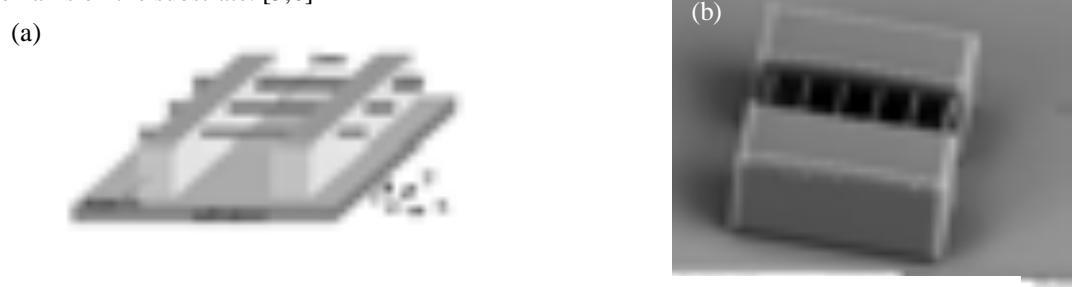
Fig. 1. (a) Scheme for the fabrication of lines. Lines thicken as the number of scans increases from 1 to 3 corresponding from bottom to top; (b) the microstructure out of Zr containing hybrid organic-inorganic biocompatible polymer SZ2080. [7]
To be able to form precise structures it is required to investigate how modification of the different fabrication influences the resolution of the fabricated structure. In this report, we present micro structures fabricated out of photopolymer SZ2080.The dependence of fabrication parameters on laser irradiation power, number of scans and sample translation velocity was investigated. The resolution dependence was analyzed by measuring the width and the height of all lines of the structures. Therefore, it was obtained that as the number of scans over the same area is increasing, the width and the height of lines are also increasing. Other conclusions were derived from the investigations of line width and height dependences on sample translation velocity and irradiation power.
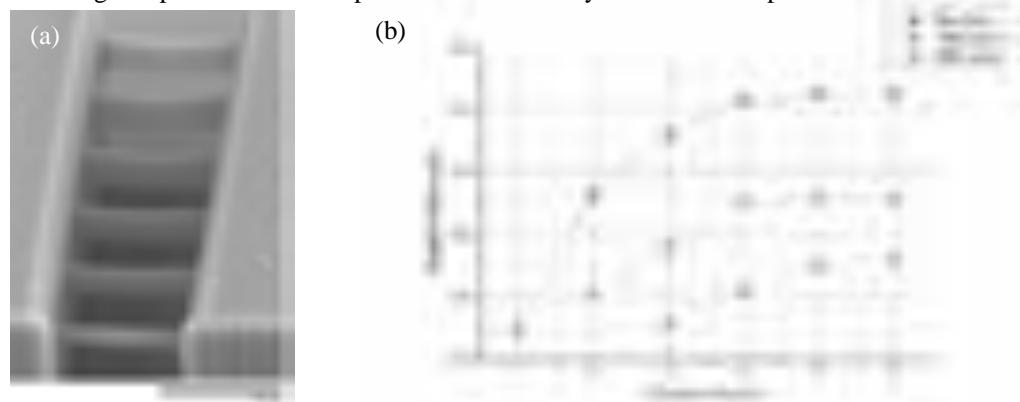
Fig. 2. (a) SEM image of fabricated lines. The sample translation velocity was 50 μm/s, irradiation power - 14 mW and the number of scans increased from 1 to 6 corresponding from bottom to top. The height of lines varies from 2,23 to 4,12 μm; (b) the graph shows the height of line dependence on number of scans with different sample translation velocities.
[1] S. Kawata, H.-B. Sun, T. Tanaka, K. Takada: Nature412, (2001) 697-698.
[2] J. Serbin, A. Egbert, A. Ostendorf, B. N. Chichkov, R. Houbertz, G. Domann, J. Schulz, C. Cronauer, L. Fröhlich, M. Popall: Opt. Lett, 28(5), (2003) 301-303.
[3] R. Houbertz: Appl. Surf. Sci.247, (2005) 505.
[4] S. Juodkazis, V. Mizeikis, K.K. Seet, M. Mima, H. Misawa, Two-photon lithography of nanorodsin SU-8 photoresist, Nanotechnology16, 846– 849 (2005).
[5] H. -B. Sun and S. Kawata, Two-Photon photopolymerization and 3D lithographic microfabrication, Adv. Polym. Sci.170, 169-273 (2004).
[6] M. Malinauskas, H. Gilbergs et al., Femtosecond laser-induced two-photon photopolymerization for structuring of micro-optical and photonic devices, Proc. of SPIE7366, 736622 (2009).
[7] A. Ovsianikov, J. Viertl, B. Chichkov, M. Oubaha, B. MacCraith, I. Sakellari, A. Giakoumaki, D. Gray, M. Vamvakaki, M. Farsari and C. Fotakis, Ultra-Low Shrinkage Hybrid Photosensitive Material for Two-Photon Polymerization Microfabrication, ACS Nano2(11), 2257-2262, 2008.