
Large Hadron Collider (LHC), currently used Si detectors is not sufficiently hard for ionizing radiation, which over time may be rendered unsuitable for use. In 2002 European Centre for Nuclear Research (CERN) created RD50 research program that sought to improve existing and new materials and structures suitable for new detectors. One of the most promising material is silicon, the modification is expected to achieve the desired results.
This work goal was to analyse deep levels and traps generated by hadrons in silicon.
Measuring photoconductivity spectra and analysing it using Lucovsky model [1], deep centers activation energy and concentration levels of defects was determined (Fig. 1). Using Gauss approximation was determined samples deep levels bands energies: 0,38eV; 0,66eV; 0,821eV; 0,81eV.
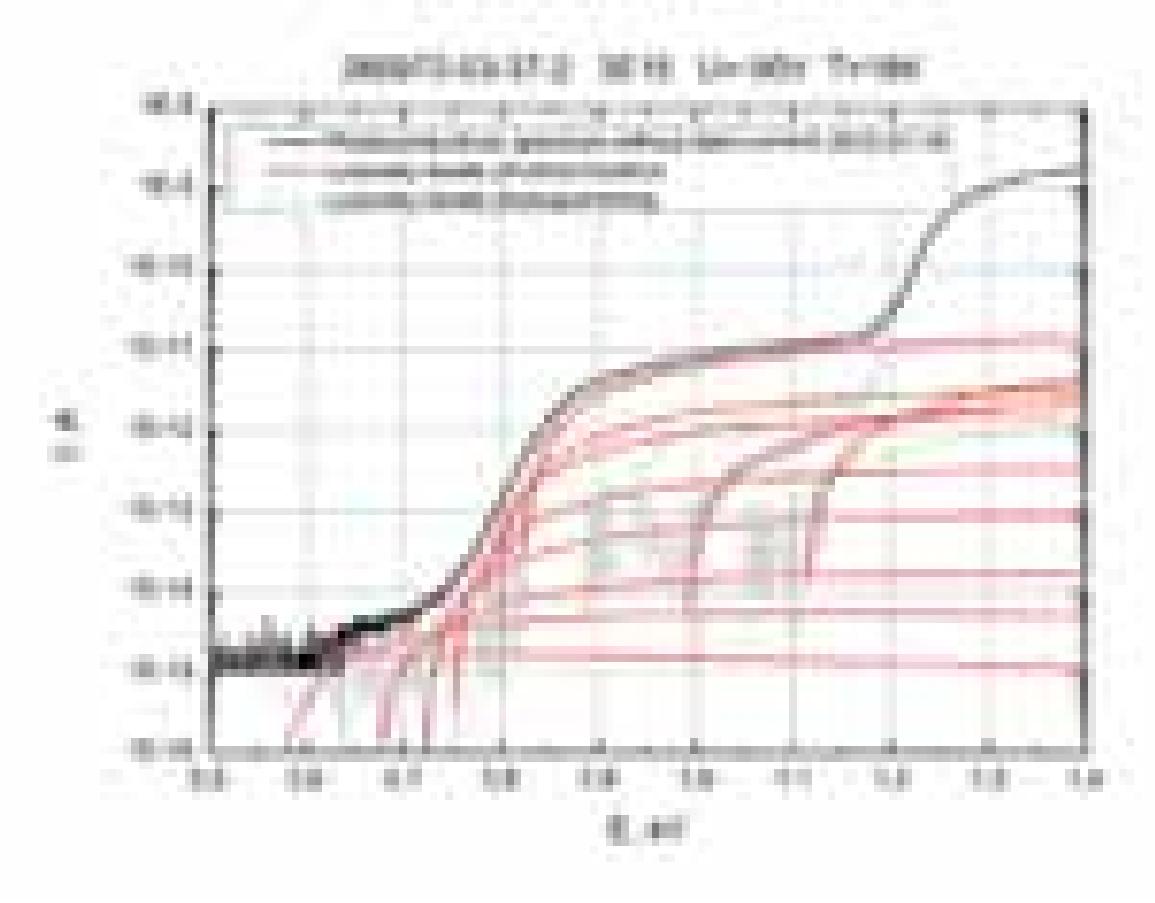
Heat stimulated current method was used to determine the adhesion levels, which could not be observed using photoionization spectroscopy, of sample with a thermal activation energy values: 0,456eV; 0,442 eV; 0,413eV; 0,308 eV; 0,243 eV; 0,173 eV; 0,061 eV ir 0,019 eV.
Using additional lighting from second monochromator it was found that localized levels influence the conduction band modulation and ionizing different levels, these barriers can be reduced or increased.