Due to the limited amount of fossil fuels and an increasing interest in sustainable energy light emitting diodes (LEDs) are getting more popular in lighting applications [1]. In order to design a white light LED two different methods are used. One is to combine red, green and blue LEDs and other is to use a phosphor converted LED (pcLED) [2]. The latter method requires a blue or a UV LED which is covered by a thin layer of phosphorous material. A phosphor is excited by blue light and emits yellow light, this process is called photoluminescence [1]. The excess of blue light penetrates the phosphor and mixes with yellow thus creating white light [2]. In case of a UV LED it is covered by two different phosphor materials that convert UV light to blue and yellow. Different phosphors enable to design LEDs in a broad range of wavelengths thus they can be used for various applications. One of them is to use LEDs in greenhouses for illumination of plants. It is known that in order to grow and develop plants need three ranges of wavelengths - 400-500, 620-680 and 700-760 nm. These wavelengths are responsible for the processes of photomorphogenesis, phototrophy and photosynthesis [2]. While LEDs with quite good characteristics in ranges around 460 and 600 nm were designed, there is still no good LED in a far-red region which is important for the process of photomorphogenesis. The GaAs LED that emits around 730 nm is made of toxic materials and is very sensitive for temperature differences and humidity thus it is not applicable for greenhouses [3].
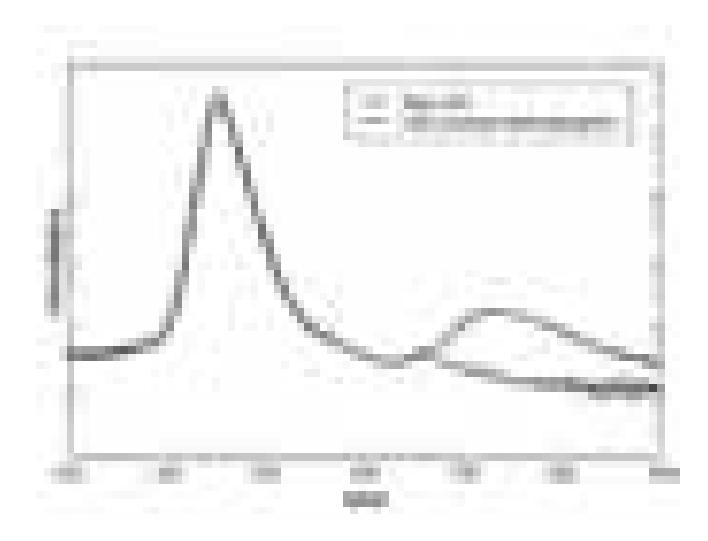
The aim of this reasearch was to design a pcLED based on a blue 445 nm GaN LED and a Gd3Ga5O12:Cr phosphor and which could satisfy the photomorphogenetic needs of plants in greenhouses. During the experiment phosphors with different dopant concentrations converting blue light to far-red light were sintered in the faculty of Chemistry of Vilnius University by a sol-gel method. Their optical properties such like excitation, luminescence and quantum efficiency were measured in the faculty of Physics of Vilnius University. The most efficient material was found to be Gd3Ga5O12:Cr 5 mol%. It was used to design a pcLED which emits light in the ranges of 400-500 and 700-760 nm that satisfy the photomorphogenetic needs of plants. The spectrum of a designed pcLED is given in the figure bellow.