The Protons conducting solid electrolytes have a wide range of technological applications in batteries, fuel cells, sensors, dehydration/ hydration of hydrocarbons, electrolysers and etc. The proton conductor Yttrium doped Barium cerate for example BaCe0.9Y0.1O3-δ (BCY10) shows the highest conductivity among all proton conductors [1].
In the previous studies it was found that pressing increases the proton conducting activation energy [2]. This is an indication that activation energy decreases linearly with the lattice parameter. Here only the lattice volume was considered, but the pressure also affects other structural properties of the materials, for instance the size of grains, and the crystal orientations, and thus influence the proton conductivity [3]. In this work, we apply different pressures (100-600 MPa) during the preparation of the pellets.
The X-ray diffraction was measured and the peak height ratio was calculated for neighboring diffraction peaks. It was observed, that the ratio of the peak intensity varies upon pressure. It means that pressure changes the preferred orientation of the crystals The Highest Peak Height Ratio is at the pellet prepared using 500 MPa pressure. The height ratio of (2 0 2): (0 4 0) peaks is the highest, therefore we assume that more crystallites are orientated in (2 0 2) direction instead of (0 4 0). The size of crystallites was calculated. The largest crystallites were obtained at the 500MPa pellet, the smallest at 600 MPa and the others in between.
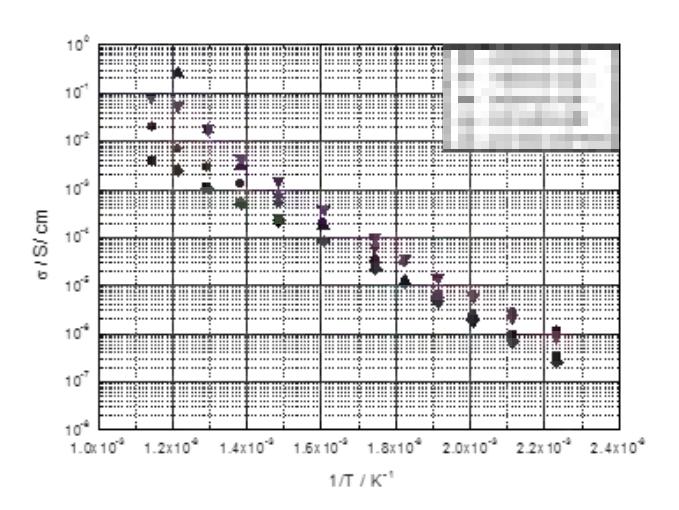
The impedance spectrum was measured in the frequency range of 0.1 Hz – 10MHz at the 448 K – 873 K in two different atmospheres using O2 gases. Figure 1 shows the grain boundary conductivity dependence according to the temperature for the pellets pressed using different pressures. The conductivity increases with a size of crystallite. Here it was noticed that highest conductivity was reached at the pellet pressed with 500 MPa pressure, which indicates an anisotropy in conductivity (protons prefer to move in (2 0 2) direction).