
Nowadays photovoltaic systems are really reliable and moderately effective but further innovations in this field are required to ensure sustainable industry growth and to increase competitive of photovoltaic technology. All standard photovoltaic modules incorporates antireflection layer usually it is tempered glass. Usage of tempered glass has its own downsides such as increased weight of PV module. Tempered glass weight limits areas where PV modules could be used. Organic based materials may be solution that can help reduce module weight.
Lighter PV modules could be made from organic based materials but all organic based materials properties decrease under UV radiation. Organic based coatings can be protected from UV by incorporating quantum dots which will absorb higher energy photons (2,5 -3,5 eV) and re-emits two or more lower energy photons (1 - 2,5 eV).
Down converting layer on silica PV element has capability to generate more than one low energy photon form a high energy photon. Down shifting process is based on luminescence effect but in this type of application the high frequency quantum that is being absorbed is converted into one long-wave quantum.
To create down converting layer LumidotTM quantum dots were being used together with Leucophor OBO organic material to form down shifting layer which absorbs light at 340-370 nm and emits in a blue range of spectrum 420-470 nm.
PV samples were coated using centrifugal coating device KW-4A. Analysis of spectral transmittance of top coating layer that incorporates CdSe-ZnS quantum dots was tested with UV-VIS spectrophotometer. The results are shown in Fig.1
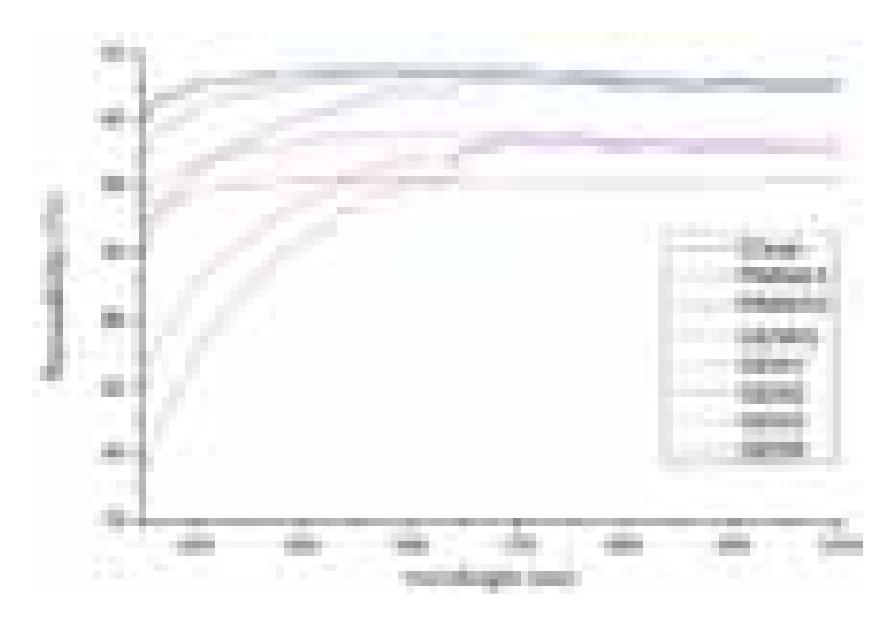
Electromagnetic wave absorption can be seen in a wide (350-650 nm) wave length range. Few maximums can be seen in results chart which amplitude depends on organic solution concentration.
Results confirmed that it is possible to widen PV absorption spectrum using quantum dots in organic based materials. This method increased PV efficiency by 1 percent.