
Currently there is a huge interest in Silicon-on-Insulator (SOI) nanophotonics and its application for signal processing and transmitting [1]. One of the main problems in SOI nanophotonics is efficient coupling of light into the optical circuits. Efficiency of end-fire and butt coupling methods very much depends on reflections from interfaces and spatial alignment of waveguides and their fields. An alternative method to couple light is using of diffraction gratings, made out of periodic sub-wavelength structures. Efficiency of such couplers may exceed 50% or even 70%, if multilayer reflectors are used.
The aim of this work was to create a device composed of sub-wavelength structures that would work as a lens spot-size converter for wavelength of 1.55 μm (optical communication wavelength). Such device would allow to significantly decrease length of tapers, that connect SOI waveguides and diffraction gratings couplers.
Here we propose a subwavelength SOI structure with effective gradient index similar to Lüneburg lens, mentioned in [2]:
$$n(r) = n_0 \sqrt{2 - k(r/R)^2}$$Where R is the radius of the lens region, k is the ratio of lens area and ideal Lüneburg lens area, $n_0$ is the ambient index outside the lens region and r is the radial polar coordinate with the lens region as origin. Unlike the ideal Lüneburg lens, which focuses a plane wave on the spot of its surface, this lens has a greater focal length, which depends on k.
The effective refractive index of the SOI media was calculated using methods described in [2] and [3]. For simulation of electromagnetic wave propagation in such structures we used “MEEP” software package [4] based on a Finite Difference Time Domain (FDTD) method.
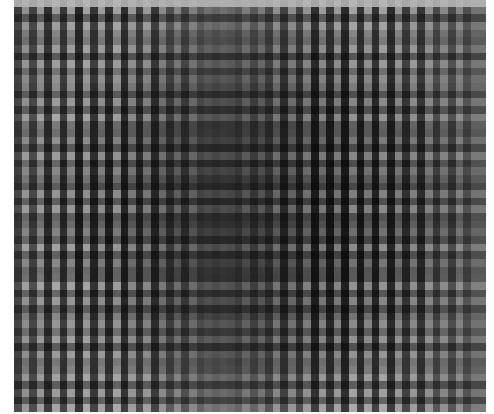
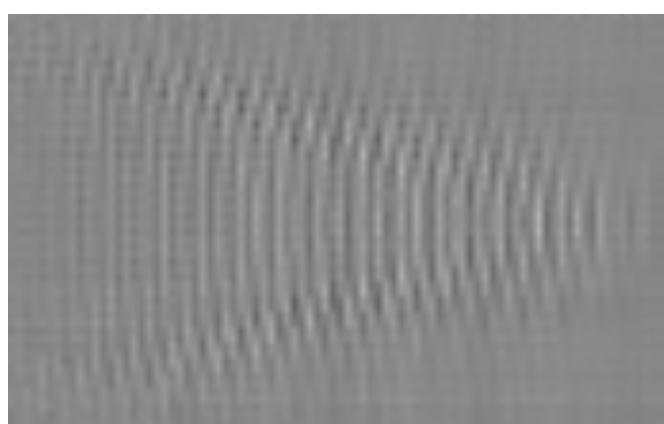
An example of simulation results is presented in Fig. 1 and Fig. 2. Fig. 1 shows a design of gradient index lens structure. White color represents material of low permittivity, while black color represents material of high permittivity. Fig. 2 shows how this lens focuses a plane wave.
In conclusion, it was shown, that modulating the size of holes in subwavelength SOI structure, the effective gradient index Lüneburg lens can be created to convert spot-size of coupled waves to SOI waveguides.