Chaotic behaviour has been firstly observed, yet not comprehended, by Poincare [1]. Well established research about a system of differential equations describing the convective motion of the atmosphere was held by Lorenz in 1963. Further investigation showed the existence of many discrete (logistic, Chirikov standard map) and continuous (Henon-Heiles, Duffing oscillator) systems. In fact, the amount of nonlinear systems behaving chaotically is much greater than the 'properly' behaving linear ones. It turns out, that even drops dripping from the tap are acting chaotically [1].
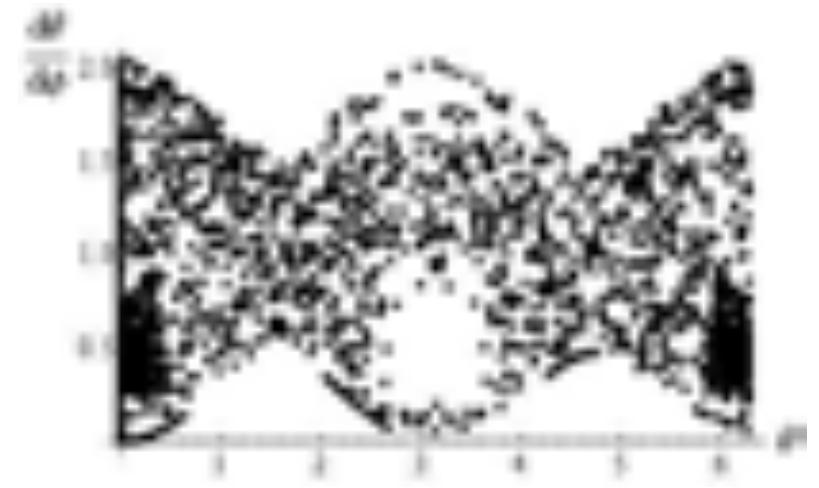
A classical mechanics example for a system that could be chaotic for some specified parameters is a rotation of a non-spherical rigid body. Fixing the spin axis orthogonally to the orbit's plane one can achieve the equation of motion [2] in the form (1). Although, the non-sphericity must be sufficiently big, that is there should not be (B-A)/C<<1, where A, B, C are the principal moments of inertia. For Hyperion we have $\omega_0^2 = 3(B – A) / C = 0.87$, so it is expected to find a large chaotic zone in the phase space. That is actually true, as shown in figure 1.
$$\ddot{\theta} - 3(B-A)/C \sin(2\theta) = 0\tag{1}$$The Lyapunov theory of stability shows that the model of Hyperion actually acts chaotically and the Chirikov criterion states that the critical value of $\omega_0$ is given by
$$\omega_0^{RO} = \frac{1}{2 + \sqrt{14e}}\tag{2}$$which for e=0.1, the mean eccentrity of Hyperion is equal to $\omega_0^{RO}=0.31$.