
Lead containing piezoelectric ceramics and single crystals have been widely used as actuator, transducer, and sensor materials. However, the toxicity of lead oxide has led to a demand for alternative materials that are more environment friendly. (Sr1-1.5xBix)TiO3 - strontium bismuth titanate (SBT) is one of such compounds.
It is well known that in pure incipient ferroelectrics, like KTaO3 or SrTiO3 polar phonons, mainly soft modes, are responsible for the dielectric permittivity and no pronounced dielectric dispersion is observed below the soft-mode frequency [1]. The ferroelectricity in such materials can be induced by application of sufficiently strong electric field, uniaxial stress or substitution of A-site ions by isovalent or heterovalent ions. Scanavi [2] discovered that (Sr1-1.5xBix)TiO3 ceramic with small to moderate Bi content exhibits dispersion similar to relaxor ferroelectrics. Further dielectric studies on SBT ceramic (up to x≤0.17) [3, 4] showed that Bi doping induces formation of local antiferrodistortive and polar regions. This causes complex relaxational dynamics below the phonon frequency range. The aim of this work was to extend the investigations of dielectric dispersion in SBT for concentrations x=0.1 and x=0.15 to GHz range, since no broadband dielectric studies (on our knowledge) have been carried out for SBT with bigger bismuth content.
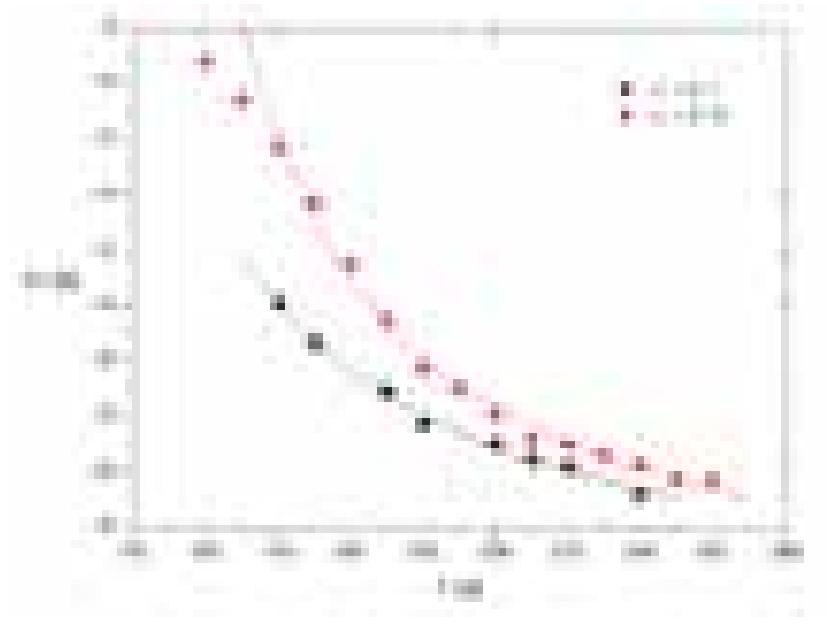
Experimental data have been analysed in terms of Havriliak-Negami formula. The obtained mean relaxation times fulfills the Vogel-Fulcher relationship with following parameters for SBT with x=0,1 and x=0,15 respectively: dipole freezing temperature T0=60,94 K and T0=87,93 K, dipole activation energy U=950,67 K and U=952,72 K, dipole relaxation at very high temperatures τ0=9,7·10-14 s and τ0=7,69·10-14 s.