
Nanotechnology is a field of great interest because nanoparticles exhibit unique properties and can be used in a lot of different areas such as biomedicine, electronics, chemical catalysis, material science etc. Pulsed laser ablation of solids in liquids is an attractive method to synthesize nanoparticles due to simplicity of the procedure, high chemical purity of nanoparticles and possibility to generate nanoparticles of various materials (metals, alloys, semiconductors) [1].
Electromagnetic field, incident upon nanoparticles of noble metals, excites localized surface plasmons (LSP), i.e. collective oscillations of conduction electrons in nanoparticles [2]. Resonant LSP frequency lies in UV-Vis spectral region and depends on the size and shape of nanoparticles so it is possible to determine the mean size of nanoparticles from their absorption spectra [3, 4].
The aim of our work was to generate gold nanoparticles in distilled water using fundamental (1064 nm) and second (532 nm) harmonics of nanosecond diode-pumped Nd:YVO4 laser and to evaluate their sizes. The goal was to find the optimal experimental conditions for the highest productivity of nanoparticles.
Absorption spectra of colloids, obtained using different scanning speeds (different interpulse distance on the target) are shown in Fig. 1. Fundamental harmonic (average power 5.5 W, pulse repetition rate 10 kHz) was used and ablation time was 15 minutes.
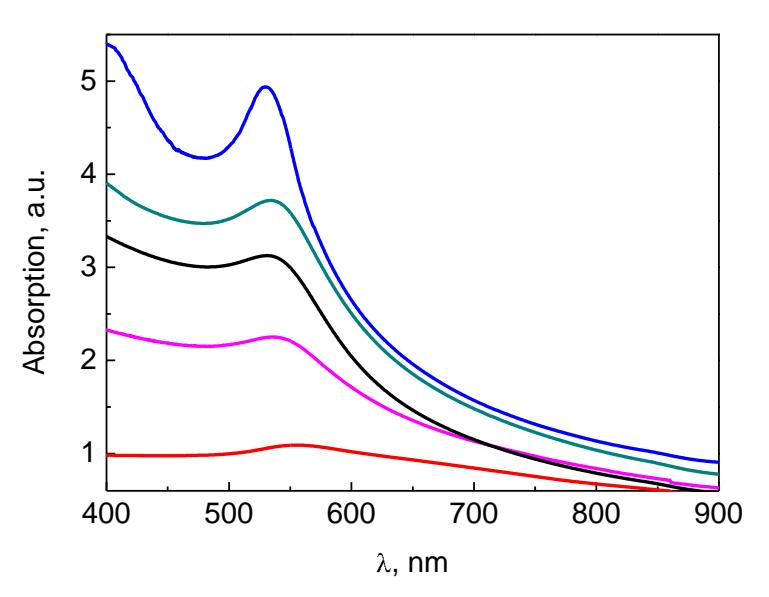
The mean sizes of nanoparticles obtained in different experiments varied from 30 to 90 nm. However, repeatability of our experiments was quite low, therefore further investigations are needed for better understanding of the nanoparticle generation processes.
Research was done at Department of Laser Technologies of the Center for Physical Sciences and Technology.