Light emitting (LED) and laser diodes are widely used in everyday life in lighting, information storage or telecommunication fields. Although currently quite expensive, LED general lighting is becoming more popular every day for it is far more efficient than ordinary lighting with incandescent light bulbs. Therefore, a lot of effort is put into trying to better understand all the physical processes of such technology and making it cheaper. InGaN is one of the compounds used for various types of LEDs because of suitable optical properties and adjustability. By changing the amount of indium in such a compound one can shift the band gap from 675 nm to 370 nm, which covers near infrared, visible and ultraviolet light.
In this work, four different structures were analyzed using a light-induced transient grating (LITG) technique [1]. In this technique, a sample is excited by an interference field of two coherent beams creating a transient diffraction grating, which is probed by diffraction of the delayed probe beam. In the used experiment setup, the wavelengths of the pump and the probe beams were 355 nm and 532 nm, correspondingly. The samples were GaN, 100 nm thick In0.1Ga0.9N layer and two (In,Ga)N multilayered LED structures.
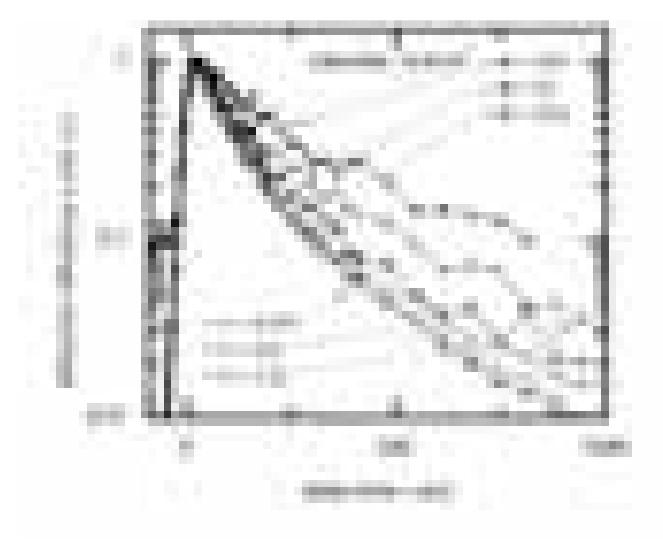
It has been found that at fixed pump intensity the recombination rate significantly differs from sample to sample; e.g., at 0.375 mJ/cm2the recombination time was τR=1.38±0.08 ns in GaN and τR=0.32±0.02 ns in In0.1Ga0.9N. Furthermore, the recombination rate showed qualitatively different dependence on excitation: in GaN sample it increased with carrier density due to the onset of nonlinear recombination, while with InGaN decay became slower. The latter fact was attributed to the saturation effect of defect-related recombination centers, which were apparently abundant in In0.1Ga0.9N sample [2]. LED structures exhibited non-monotonic recombination rate dependence on excitation. At relatively low intensities, recombination became faster due to nonlinear recombination (most likely band-to-band transitions). But after reaching an intensity of ~0.24mJ/cm2, recombination rate reached saturation and began to decrease, as shown in Fig. 1. Such dependence can be explained with saturation of electron states in quantum wells ('carrier spillover' effect) and consequent saturation of defect states outside the quantum wells [3]. The samples containing indium showed the decreasing in diffusivity with higher intensity of pumping beam. This might be regarded to the rising number of phonons or electrons, which results in greater scattering.