
Creating new intervertebral disc hernia diagnostics means is necessary. Not only because sciatica (lower limbs and low back pain) induces pain and makes people suffer from it, but also because it causes economical damage as well [1]. According to studies, 70 to 85% of people population will suffer from sciatica in their lifetime [2].
Pairing contemporary intervertebral disc hernia diagnostics methods (Magnetic Resonance Imaging and Computed Tomography) with vibrational spectroscopy (and maybe luminescence) may help developing new tools to diagnose and to spot intervertebral disc herniation sooner than ever before.
Fourier transform Raman spectroscopy (FT-Raman) is a powerful technique to examine all kinds of material's properties. In this experiment we used modern FT-Raman microspectrometer “MultiRAM” (Bruker Optik GmbH, Rudolf-Plank-Str. 27, D-76275 Ettlingen, Germany. Software version: OPUS 6.5) to register scattering spectra of intervertebral disc hernia tissue in vitro.
Samples were excited by Nd:YAG Senza HP - 1064nm laser (KLASTECH - Karpushko Laser Technologies GmbH. Konrad-Adenauer-Allee 11, D-44263 Dortmund, Germany). Gathered data was processed with OPUS 6.5 and OriginPro 8.5 software. Results helped to find and to assign certain vibrational bands to this material's specific molecular vibrations.
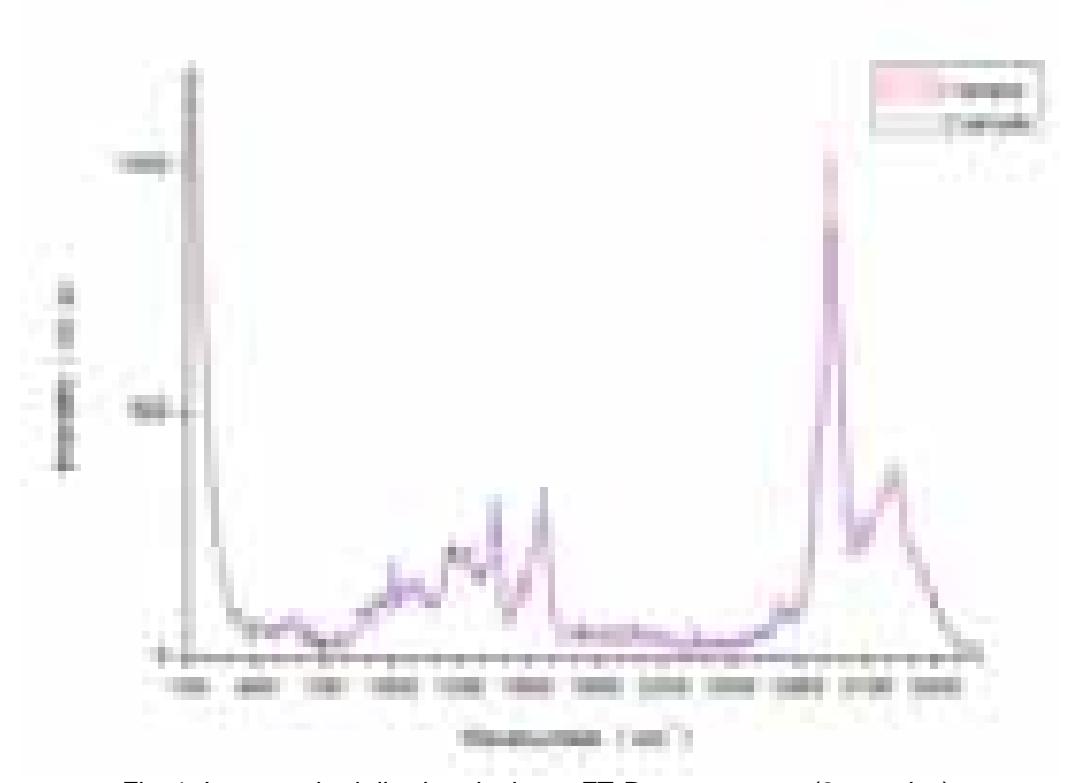
Spine, vertebral, intervertebral disc anatomy, diagnostic methods like MRI and CT were reviewed. Raman scattering mechanism was also explained in a theoretical investigation. Intervertebral disc hernia tissue Raman spectra were registered for the first time. The parameters for the best sample spectra were defined.