
Enhancement of reactive oxygen species (ROS) production plays a crucial role in disease development. Excessive intracellular ROS levels are observed in different pathological conditions, including inflammation, atherosclerosis and cancer. Cancer cells have been shown to possess an ability to produce more ROS when compared to normal cells [1]. Excessive ROS production may promote cancer cell survival and proliferation, thus contributing to cancer development. Moreover high levels of ROS may potentiate metastatic processes mediating cell invasiveness and cell migration. Platelets may contribute to propagation of cancer cells. During cancer metastasis, formation of platelet-tumor cell heteroaggregates, facilitating immune evasion and microvascular arrest of cancer cells at distant sites, is observed [2]. Therefore development of new therapeutic strategies aimed at prevention of platelet-tumor cell heteroaggregates formation and targeted to persistent pro-oxidative state characterizing cancer cells is considered to be of significance.
In the present study processes of platelet and breast adenocarcinoma cells MCF-7 heteroaggregates formation in presence of ascorbic acid was investigated. Cancer cells ($2\times10^5$ cell/ml) were added to platelet suspension and incubated under continuous stirring at 37 °C. Pletelet-tumor heteroaggregates formation was shown to have three phases of aggregation: lag-phase with duration of about 10-14 min and two aggregation waves (Fig. 1, curve 1, lag-phase and first aggregation wave are shown). Preliminary incubation of platelets with ascorbic acid (antioxidant, have being shown to induce death of cancer cells with no cytotoxic effect on normal cells) at different concentrations led to a dose-dependent increase in duration of lag-phase (Fig. 1, curves 2 and 3). In presence of physiological ascorbic acid concentrations (200 μM) increase in lag-phase time was 36%, while at pharmacological ascorbic acid concentrations (5 mM) increase in lag-phase time was about 200%.
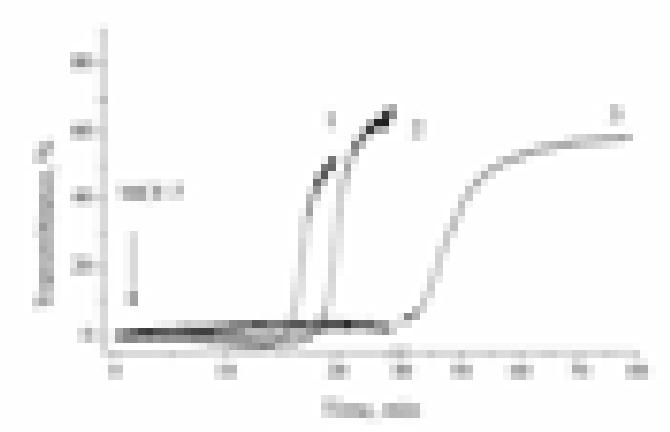
Data obtained are in agreement with [3], where ascorbate depletion in mice unable to synthesize ascorbic acid has been shown to increase growth and metastasis of melanoma cells.
Tumor-induced platelet activation may cause the release of various cytokines, including CD40 ligand (CD40L – a transmembrane protein structurally related to tumor necrosis factor-α). Activation of the CD40/CD40L pathway has been suggested to enhance the procoagulant activity of tumor cells [4]. Recently ascorbic acid has been ascertained to inhibit platelet CD40/CD40L pathway [5] permitting to assume that inhibitory effect of ascorbic acid on platelet-tumor heteroaggregates formation, obtained in our present work, is likely associated with influence of ascorbic acid on CD40/CD40L pathway.