Na1/2Bi1/2TiO3 (NBT) is one of the most studied ferroelectric system. Unique features and peculiarities of phase transitions attracted much attention by the scientists. NBT and its solid solutions were widely studied since it was synthesized in 1960. SrTiO3 (ST) and PbTiO3 (PT) were used as a secondary materials with NBT. It is well known that ST and PT act differently upon the NBT [1]. Strontium titanate enhances relaxor properties while lead titanate increases characteristics of 1st order phase transition.
Dielectric measurements were made for x = 0 - 0.25 in 35-500K temperature range and 0.01 Hz – 40 GHz frequency range on cooling with 1 K/min rate, except near phase transitions where it was lowered to 0.4 K/min. Silver paste was used for contacts. Investigations from 20 Hz to 1 MHz were made by measuring capacity and loss tangent with LCR meter HP-4284A. Measurements in 1 MHz – 3 GHz range were made with vector network analyzer Agilent 8714ET in a coaxial line terminated by a capacitor. In 8 - 40 GHz frequency range measurements have been performed by scalar network analyzers R2400 produced by “Elmika” company in a waveguide setup. Complex dielectric permittivity was calculated from absolute values of reflection and transmission coefficients.
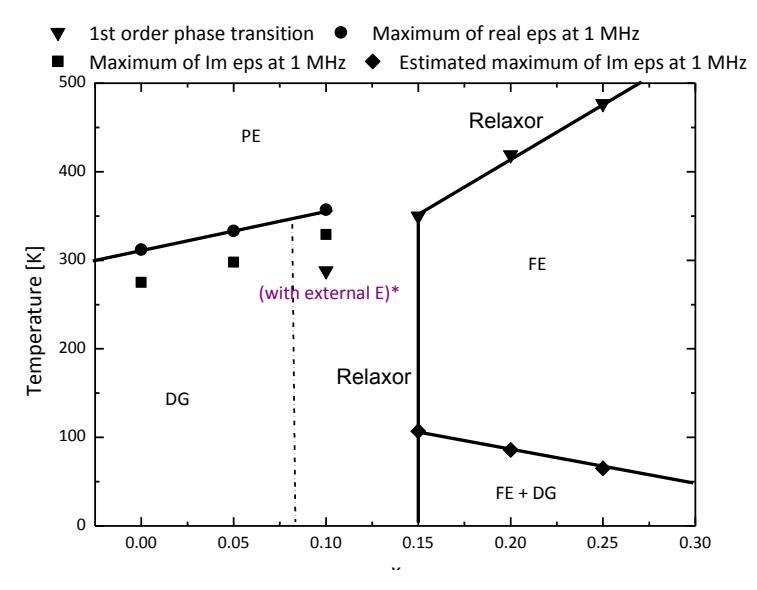
Fig. 1 shows phase diagram of 0.4NBT-(0.6-x)ST-xPT system. Variation of x in the solid solution radically changes physical properties of these ceramics. This indicates that lead titanate plays important role in such solid solutions. Different radii of A-site ions change long range order. Increase of lead expands chemically ordered regions and from certain value of PbTiO3 normal ferroelectric phase occurs which spontaneously transforms to relaxor ferroelectric phase when temperature increases.
The purpose of the report is to discuss dynamic dielectric properties of this system. Also distribution of relaxation times will be presented.