
High-frequency electrodeless lamps (HFEDLs) are widely used as high intensity sources of narrow spectral lines, covering the spectrum from the vacuum ultraviolet to the infrared. Such lamps have been used in various scientific devices such as emission and absorption spectrometers, spectrometers for refractive index measurements and frequency standards. Because of the high intensity of HFEDLs, they have been used as emission sources in double-resonance experiments, sensitized fluorescence experiments and the measurement of the shifts and broadening of spectral lines. Such lamps are very convenient for plasma-surface interaction studies due to lack of electrodes, which can cause impurities in plasma [1].
Depending on the application, the requirements for the light source are different. For example, the main requirements for light sources for use in AAS are: (1) high intensity of spectral lines; (2) emission stability; (3) narrow and not self-absorbed line profiles; and (4) long-operating life. It is necessary to investigate and optimize the light sources for each particular use.
The HFEDL contains a bulb and a short side arm containing the working element. The lamp bulb is located in a HF generator coil to induce an inductively coupled electrodeless discharge. The excitation frequency of the applied high-frequency field is 100 MHz. Initially the discharge occurs in buffer gas (usually, argon), then due to the increase in temperature, the vapour pressure increases and the emission of the working element can be observed.
In this work are presented the intensity stability measurements of HFEDLs containing As, Se, Tl, Sn and Pb, developed in our laboratory for different analytical devices, particularly, atomic absorption spectrometers. The lamps were operated at different excitation generator voltage values (20-30V), and the emission spectra changes in time (for about 20 minutes) were analyzed. For several lamps the intensity stability measurements were performed for about 8 hours (Fig. 1.) at one particular excitation generator voltage value.
The emitted light spectra were registered using AVANTES AVS-PC2000 plug-in spectrometer with a 2048-element linear CCD-array detector. The spectra were recorded in the wavelength range from 190 till 850 nm.
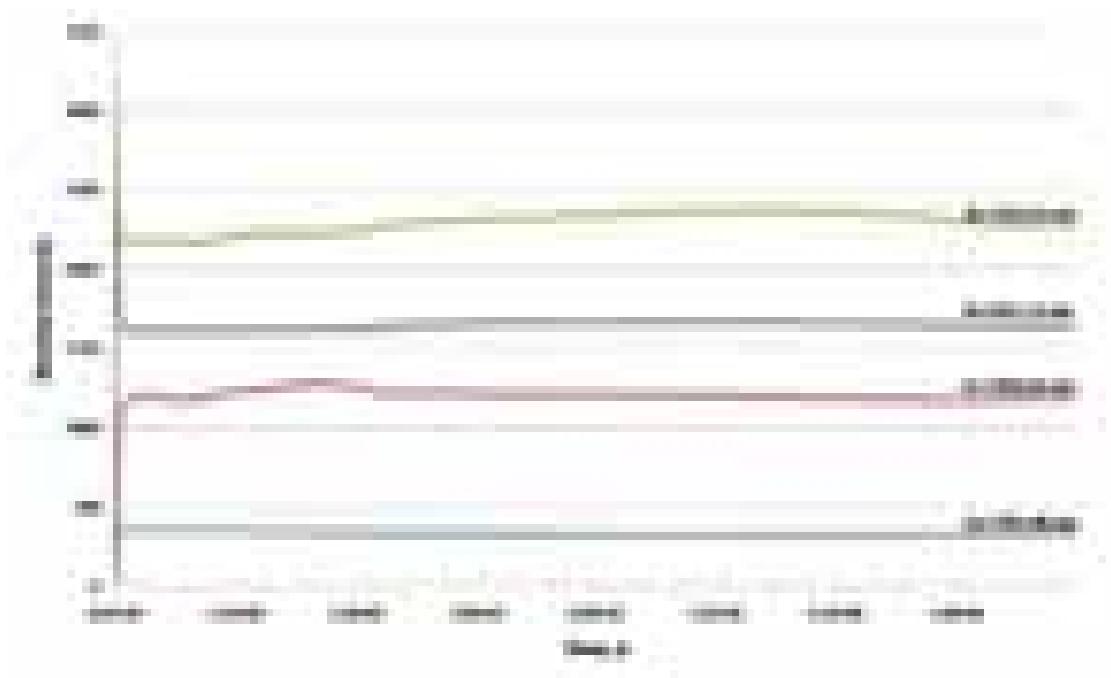
Such measurements indicate the time needed for the lamp to stabilize (mostly about few minutes), and the intensity behaviour at different voltages shows which of the regimes could be most appropriate for the particular lamp.