
Chirped pulse amplification and its extension, optical parametric chirped pulse amplification are some of the most widely used methods for producing high-energy ultra-short light pulses. In these techniques, laser pulses are stretched to avoid damage to certain optical components, amplified and then compressed again. Various stretching/compression methods have been proposed, including grisms [1]. The negative dispersion grism stretcher consists of a pair of prisms placed between two diffraction gratings. This setup is advantageous to several other systems due to compactness, high stretching ratio and tunability [2]. In this paper we present results of computer modeling and experimental characterization of a grism stretcher.
As the stretcher must be matched to the compression stages in the laser system, precise characterization of spectral phase introduced by the stretcher is required. Spectral phase can be expanded in Taylor series in the neighbourhood of a selected central frequency as
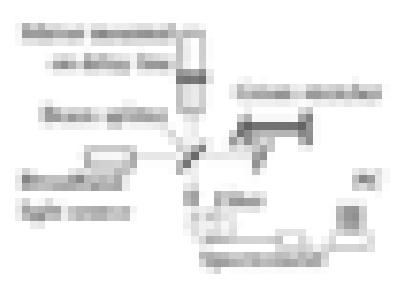
$$\Phi(\omega) = \Phi_0 + \Phi'(\omega - \omega_0) + \frac{1}{2}\Phi''(\omega - \omega_0)^2 + \frac{1}{3!}\Phi'''(\omega - \omega_0)^3 + \dots$$where the derivatives are evaluated at $\omega = \omega_0$. $\Phi'$ is called group delay and corresponds to the difference of arrival times of different spectral components at a point of observation. Once group delay values for different frequencies are known, relative spectral phase can be retrieved by integration. We performed an experiment of spectral interferometry [3] which allows direct measurement of group delay. The setup of our experiment is depicted schematically in Fig. 1.
The measurement system is based on the Michelson interferometer. As the mirror mounted on the delay line is moved, optical path lengths are equalized between the two arms of the interferometer for different wavelengths and interference fringes can be located in the spectra recorded by the spectrometer, thus allowing to determine group delay as a function of wavelength.
Having chosen the angle of incidence (AOI) of beam upon the face of the first prism, $\theta$, as the variable parameter, we obtained several datasets corresponding to different AOIs. Group delay curves retrieved from experimental data are shown in Fig. 2 along with modeling results produced by our geometrical ray-tracing simulation.

In conclusion, experimental results generally confirm modeling predictions. Measurements at different angles had to be taken at different wavelength intervals because the operational spectral range of the stretcher is strongly dependent on AOI (in general, spectral range shifts to longer wavelengths with decreasing incidence angles). Reasonably accurate modeling allows implementation of the stretcher in an operational high-power laser system.