1 Laser Research Centre, Vilnius University, Lithuania
2 Institute of Biochemistry, Vilnius University, Lithuania
3 Department of Chemistry and Bioengineering, Vilnius Gediminas Technical University, Lithuania
In the field of tissue engineering, there is a demand for many equal scaffolds made of different polymer substances. Traditional fabrication techniques such as direct laser writing (DLW) [1] are limited in their speed and have a relatively high price per scaffold. PDMS (polydimethylsiloxane) soft lithography overcomes these limitations and allows for the use of new materials that would not be processable by DLW [2]. PDMS soft lithography is a replication technique, so it requires a primary structure to be fabricated by other methods.
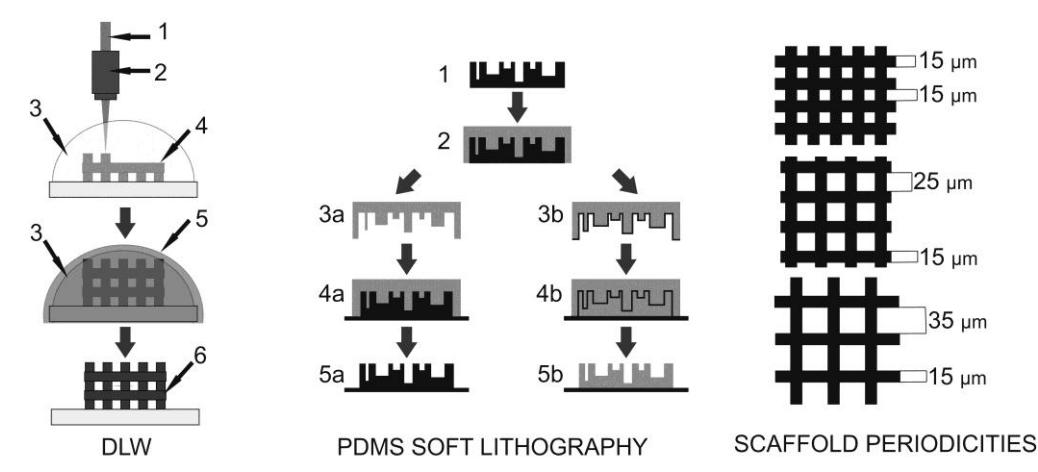
We have fabricated primary structures using DLW and replicated them using PDMS soft lithography in PDMS and PEG-DA-258 polymers. Scaffolds with different porosities were made to evaluate the optimal pore size suited for rabbit myogenic stem cell growth.
Fig. 1. DLW: 1 – laser beam; 2 – objective; 3 monomer solution; 4 – three-dimensional structure is written by changing the spatial orientation of the laser focal point to the monomer solution; 5 – developer is used to wash out unexposed monomers; 6 – a primary structure. PDMS SOFT LITHOGRAPHY: 1 – primary structure; 2 – a PDMS stamp is acquired by pouring PDMS prepolymer over the primary structure and thermal curing; 3a – a PDMS stamp of the primary structure; 4a – the stamp is used for replication in another substance by UV curing; 5a a replica of the primary structure. 3b – the PDMS stamp, acquired in step 2 is covered by a thin layer of gold; 4b – the stamp covered in Au is used to replicate in PDMS by thermal curing. 5b - a replica of the primary structure in PDMS. SCAFFOLD PERIODICITIES: 15|15, 15|25 and 15|35.
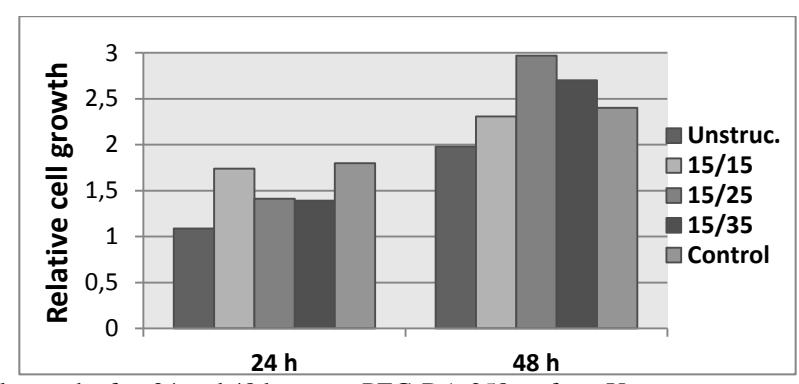
Fig. 2. Relative cell growth after 24 and 48 hours on PEG-DA-258 surface. Unstruct. – unstructured (flat) polymer surface, 15|15, 15|25 and 15|35 – scaffolds with different porosities (as in Fig. 1), Control – polystirene surface.
[1] Y. Xia, G. M. Whitesides, Soft Lithography, Annu. Rev. Mater. Sci.28, 153-184 (1998).
[2] A. Ovsianikov, S. Schlie, A. Ngezahayo, A. Haverich, B. Chichkov, Two-photon polymerization technique for microfabrication of cad-designed 3D scaffolds from commercially available photosensitive materials, J. Tissue Engin. Regen. Med.1, 443-449 (2008).