Rapid innovations in terahertz (THz) technology increased the demand for room temperature operating, stable and compact THz detectors. Special attention is given to increase the response time, providing versatility for imaging, medical diagnostic, and security aims [1]. Semiconductor electric and noise investigations can provide valuable information about the sample and its quality [2]. I-V characteristic can define samples macroscopic properties, but to understand how defects influence samples performance, voltage fluctuation analysis can be used [3]. Furthermore, noise investigation can determine how the amount of imperfections differs in separate samples made by same technology, specifying the quality of the sample and the manufacturing.
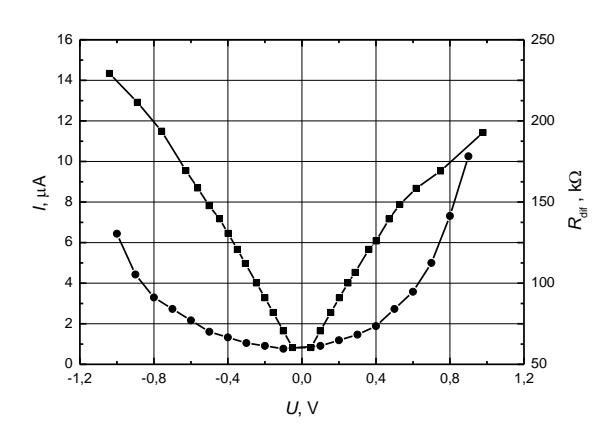
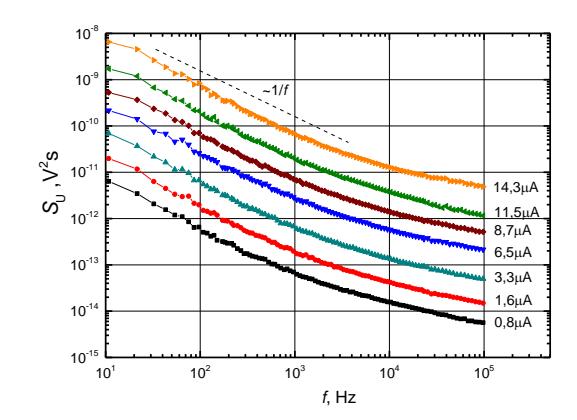
Bow-tie InGaAs-based diode with broken symmetry, used for terahertz detection at room temperature has been investigated. It consists of two leafs. One is metalized while the other is the active part, made of semiconductor. The device operation principle is based on non-uniform electron heating in its active part that contains two-dimensional electron gas while the metalized part couples the incident radiation to it. Samples electric and low-frequency noise characteristics are shown in Fig1,2 respectively.
Current-voltage analysis depicts that samples differential resistance depends on currents polarity. The asymmetrical shape of the diode influences different electric field distribution in the active region for positive and negative voltages, resulting in asymmetrical I-V characteristic.
The voltage fluctuations has been measured sustaining load resistance many times larger than the differential resistance of the sample. Fluctuations spectral density in low-frequency region can be characterized as 1/f function. This shows, that low-frequency noise is caused by recombination and capture processes in defects of the sample.