In recent years there has been a surge of developments in micro and nanoresearch, including such fields as microoptics and microfluidics. Most of these developments showed possibilities to use light and liquids in ways it was never used before as well as raised several new device conceptions such as “lab on chip" [1].
These developments could be realized because of huge advances in micro and nanostructuring technologies, such as direct laser writing technique using multi-photon polymerization. This particular technology allows fabrication of free geometrical architecture 3D objects [2] with sub-diffraction features as small as tens of nanometers [3]. Combined with fast replication technologies such as soft lithography [4] or UV lithography, it becomes possible to fabricate micro and nanostructures with high spatial resolution and precision in short periods of time.
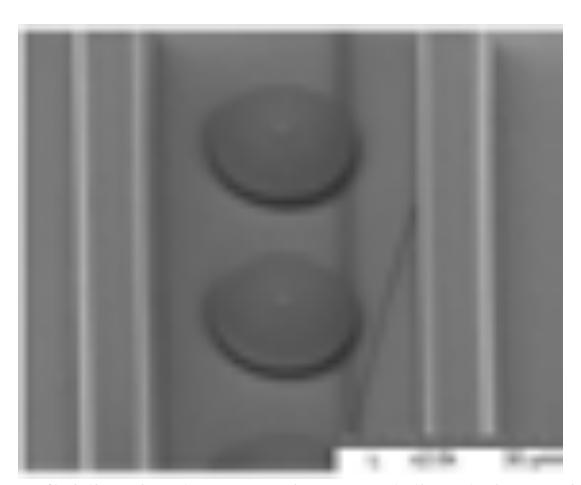
In this work we present a study of microlens arrays fabricated in SZ2080 photopolymer using direct laser writing technique. These microlenses are specially designed for use in microfluidic devices such as optofluidic sensors capable to detect changes in liquids' optical refractive index or light absorption in all or some part of spectrum. These sensors could be applied in various fields ranging from medical applications to unique industrial devices. Finally, possible optimization and simplification of fabrication process using soft and UV lithography are investigated.