
Thin film coatings are widely used in many high-tech applications in order to improve or modify optical properties of surfaces. Niobium pentoxide (Nb2O5) is very important material for optical coating technology in the visible spectral region. It is used considerably when making high refractive index thin film layers. The experimental samples of single layer coatings were deposited by using a modified ion – beam sputtering (IBS) technique on 1 mm thick fused – silica (UV grade KU 1 glass) substrates. High – energy IBS deposition is known to fulfill demanding requirements and result in high optical quality [1]. However, when dealing with high intensity lasers the optical resistance of laser components becomes an important factor limiting the lifetime of optics. In femtosecond regime laser-induced damage is driven by optical energy coupling in electron subsystem. Therefore by employing pump-probe technique here we study the electronic relaxation processes in niobia coatings induced by femtosecond laser irradiation.
| Material | lph, nm | n1064 | n1030 | EgC, eV | EgT, eV | EgU, eV |
|---|---|---|---|---|---|---|
| Fused silica substrate | 1 mm | 1,46 | 1,46 | - | - | ≈ 9 |
| Nb2O5 layer | 717 | 2,23 | 2,23 | 3,43 | 3,46 | 3,92 |
Eg - optical band gap obtained by different methods; lph – physical thickness; n – refractive index;
The pump-probe technique is based on measurements of transient laser-induced absorption. The main idea: sample is firstly exposed with an ultra-short UV pulse (pump); afterwards a broadband white light supercontinuum pulse (probe) travels through the irradiated zone and is partially absorbed by the sample. In this way, by changing the delay time between pump and the probe pulses, we can record temporal dynamics of the absorption spectrum. The initial source of both pump and probe laser pulses is a commercial femtosecond laser system, which consists of a titanium sapphire oscillator operating in a Kerr lens synchronization mode and is further amplified by (Millenia/Tsunami/Evoliution-X- /Spitfire, Spectra Physics) laser system. Most of the beam coming from the laser (95%) is directed into an optical parametric amplifier (TOPAS, Light Conversion) and the rest of the beam (5%) – to probe delay line.
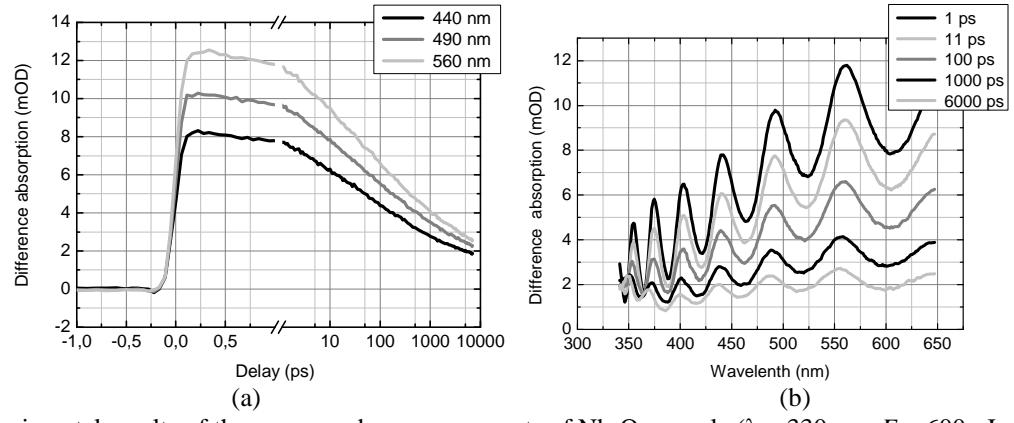
The sum of three exponential curves provides a good approximation of experimental data. The fit indicates three electronic transitions that correspond to 6ps, 200 ps, and 13 ns characteristic lifetimes. Sample absorption spectrum is blue shifted compared to unexcited state.