Femtosecond lasers opened up completely new possibilities in material processing, where events of excitation and subsequent relaxation are well separated in time [1]. This led to the use of femtosecond lasers in micro-machining, medicine and other important areas where high intensity and short pulse durations are required. With femtosecond light pulses a thin layer of material is removed with minimum damage by heat to surrounding area and therefore resulting in highest precision available. On the other hand it allowed development of the new diagnostic techniques for monitoring such ultra-fast events [2]. Regime of material ablation (surface removal) is of particular importance here, both from practical and fundamental viewpoint. The ablation process includes rich physics where different disciplines intersect. Better understanding of how high intensity short laser pulses interact with matter is essential not only to make manufacturing more efficient, but also to understand the fundamental laws of physics. In order to characterize a non-uniform density distribution close to the targets surface shadowgraphic methods can be applied. However, when the charge density of plasma is low plasma becomes transparent and therefore invisible for probing pulses. In this case light travels through plasma with a phase velocity higher than the speed of light in vacuum and as a result a strong negative change in refractive index is induced. Interferometric methods using coherent illumination are more sensitive to such phase distributions and therefore can be used for the reliable mapping of induced changes in optical density. Herewith the advantages of a new time-resolved microscopic technique [3] are demonstrated as a combination of time resolved off-axis digital holography (TRDH) and time integrated plasma emission imaging (TIPEI). Such approach allows obtaining images of the ablated plume simultaneously from both time resolved transmission (amplitude and phase) and time integrated emission in a single shot mode. The transmittance data provides information about the processes occurring inside a shock wave, while the plasma emission data gives information about spatial energy distribution. For investigation of early fs ablation dynamics a tempered carbon steel sample was chosen, because this material is widely used in industry. To achieve the desired effect often more than one laser pulse is used in the manufacturing process therefore the effect of multi-pulse ablation behavior is also investigated in this study. Spatio-temporal effects are investigated by using various pump-probe time delays while exposing the material above the ablation threshold (max. 6.45 J/cm2).
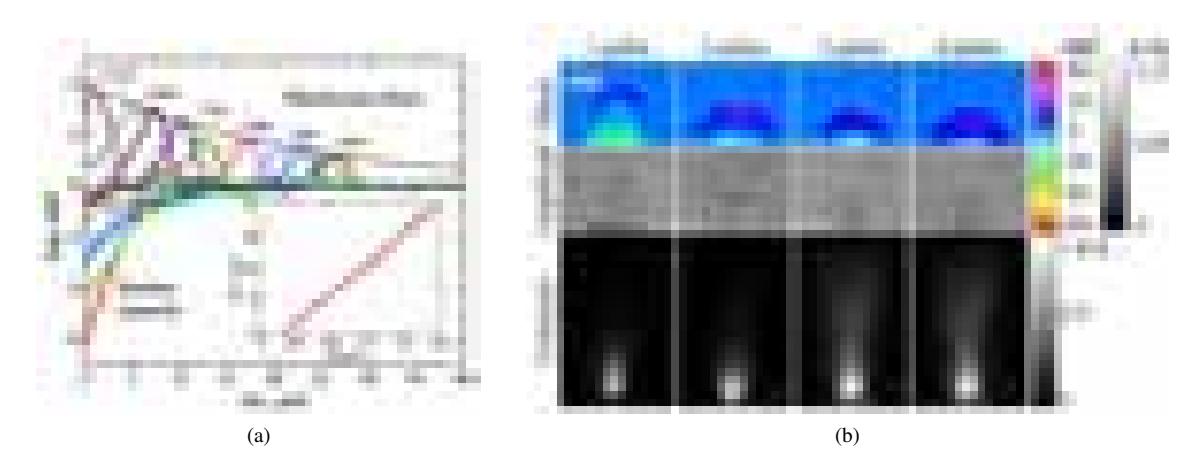
The typical results from holographic ablation experiments are shown in Fig. 1. Temporal evolution of the shock wave (Fig. 1a), emission of the ablation plume, and absorption in transmission images simultaneously (Fig. 1b), after single-pulse irradiation. Furthermore to study fatigue effect multi-pulse irradiation was used (Fig. 1b).